

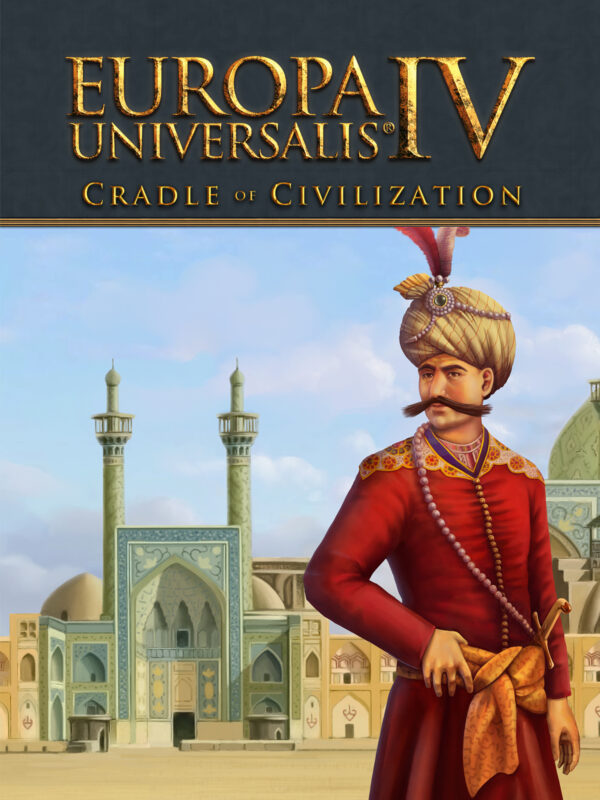
Europa Universalis IV – Cradle of Civilization DLC PC Steam CD Key
1 in stock
copies left1 in stock
Sold by: OMG Gamer






Delivery24/7
supportVerified
Sellers

Product Description
Europa Universalis IV – Cradle of Civilization DLC PC Steam CD Key
Quck Intro
Europa Universalis IV: Cradle of Civilization is a major expansion for Paradox Interactive’s grand strategy game that deepens the early modern world of empire building and diplomacy. Focused on the Middle East and Islamic regions, it refines how nations manage trade, military structure, and internal development during the 1444–1821 timeline. Players gain new tools such as army professionalism, strategic estate interactions, and more dynamic economic control, adding extra layers to long-term planning. Whether guiding the Ottomans, Persia, or smaller regional powers, every decision shapes how influence spreads across continents. The DLC emphasizes historical depth and player-driven storytelling, making each campaign feel distinct as you balance warfare, diplomacy, and expansion in a constantly shifting global map.
About
Europa Universalis IV: Cradle of Civilization is a major expansion for the grand strategy game Europa Universalis IV, expanding the experience of ruling nations during the early modern era from 1444 to 1821. Focused heavily on the Middle East and Islamic world, it deepens how empires grow through war, diplomacy, and economic control. It lets players step into the role of a ruler shaping history on a real-time strategy map where every decision affects trade routes, borders, and long-term stability. Most of your time is spent managing provinces, negotiating alliances, directing armies in wars, and optimizing trade income while balancing internal politics and estate influence. This expansion introduces systems like army professionalism, drilling forces for long-term strength, and more nuanced estate interactions that influence governance and resources. It also refines Islamic mechanics with concepts like piety and legalism, giving nations more identity-driven paths to growth and conflict. Trade becomes more dynamic across key regions such as Persia, Anatolia, and Arabia, encouraging strategic control of nodes that fuel entire economies. What makes Cradle of Civilization stand out in the grand strategy genre is its layered historical simulation, where military, economy, and religion interact in subtle but meaningful ways. Players who enjoy deep strategy games, slow-burn decision making, and long campaigns filled with emergent storytelling will find it especially rewarding. Each campaign feels different as nations evolve based on player choices rather than fixed scripts, making experimentation part of the core appeal. Whether you are shaping a rising empire or preserving a fragile state, the DLC adds depth that makes every hour on the map feel consequential and worth revisiting. It remains a thoughtful expansion for players who enjoy history-driven strategy, careful planning, and watching complex systems unfold over centuries on a living, unpredictable world map that rewards patience and long-term thinking deeply.
Key Features
Step into the role of a nation ruler in Europa Universalis IV: Cradle of Civilization, where the core gameplay loop revolves around managing provinces, negotiating alliances, directing wars, and balancing a growing economy across centuries. Every decision reshapes borders, trade routes, and long-term stability on a living grand strategy map.
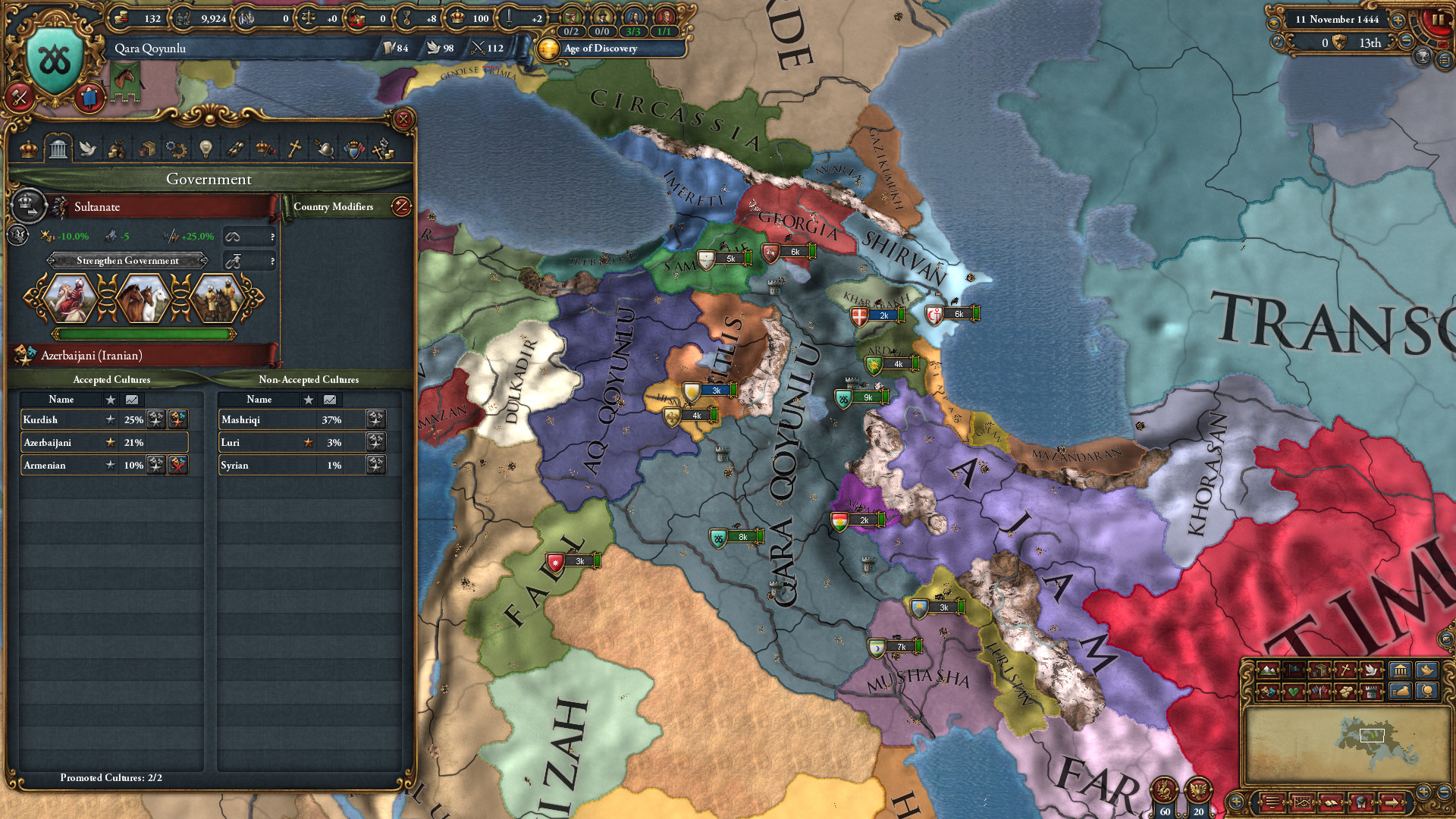
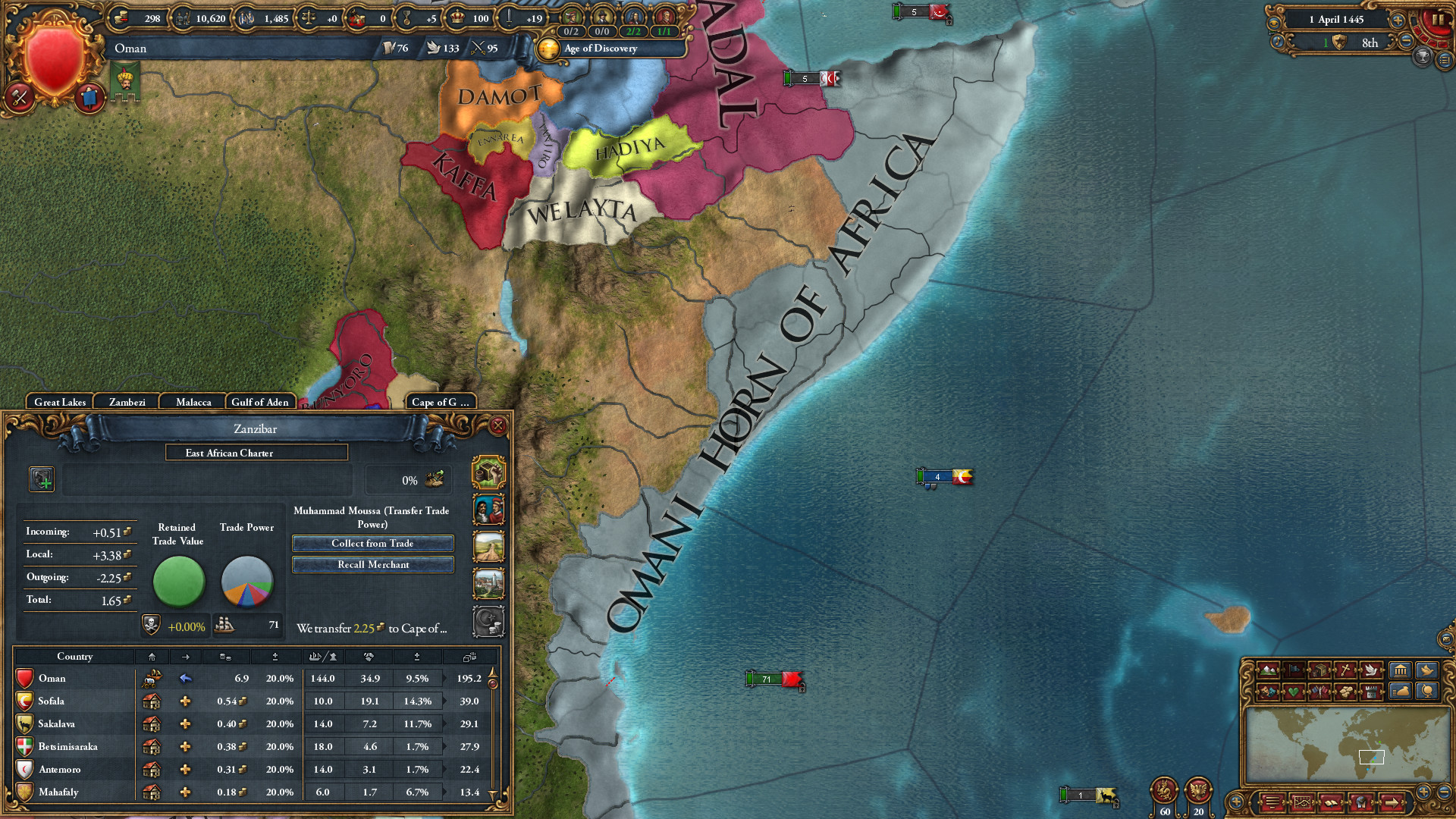
Trade networks become a central focus, especially across the Middle East, Anatolia, and Persia, where controlling key nodes can transform a minor power into a dominant economic force. Players spend time steering wealth between continents, optimizing income, and competing with rival empires for influence over global commerce.
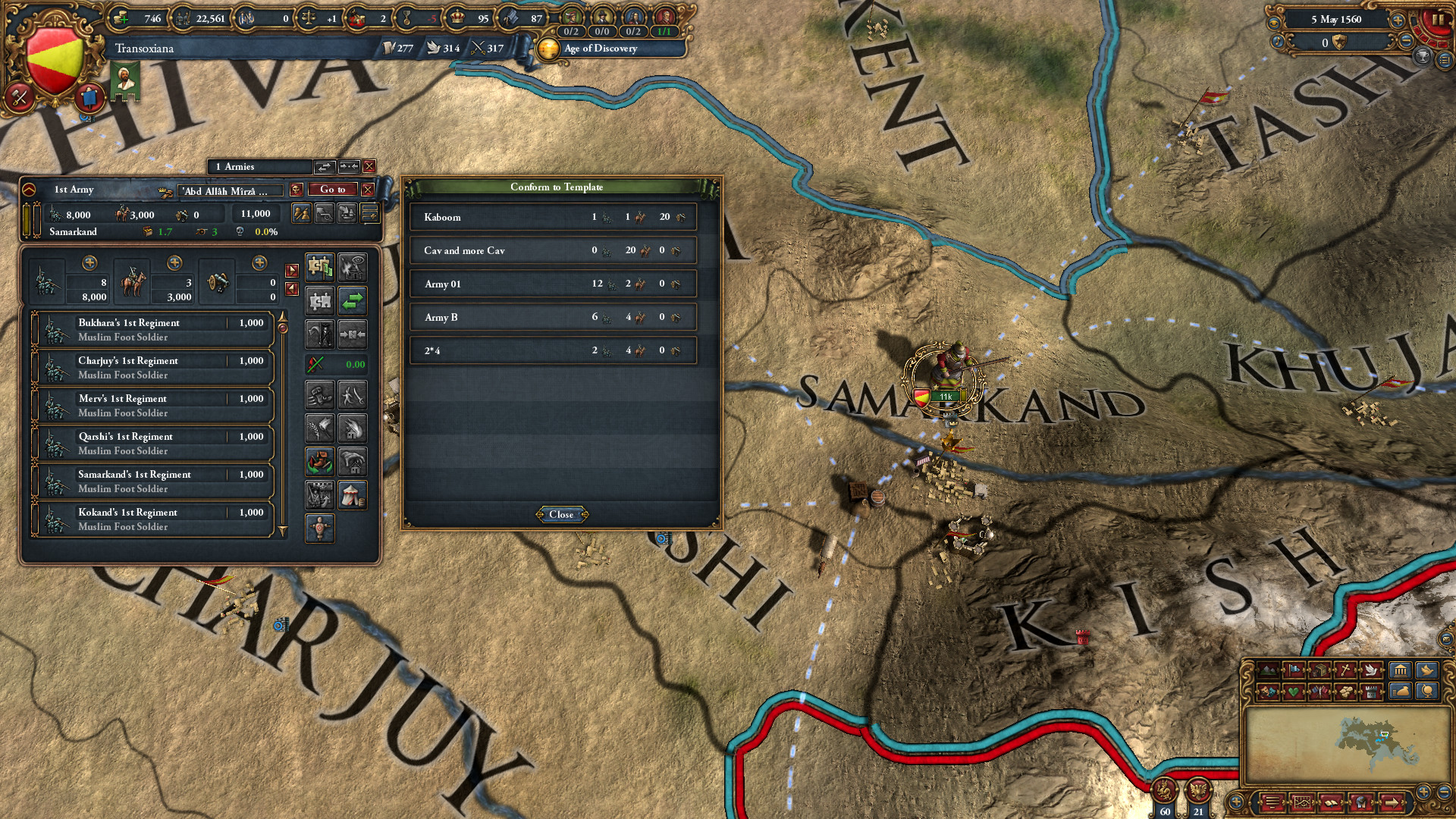
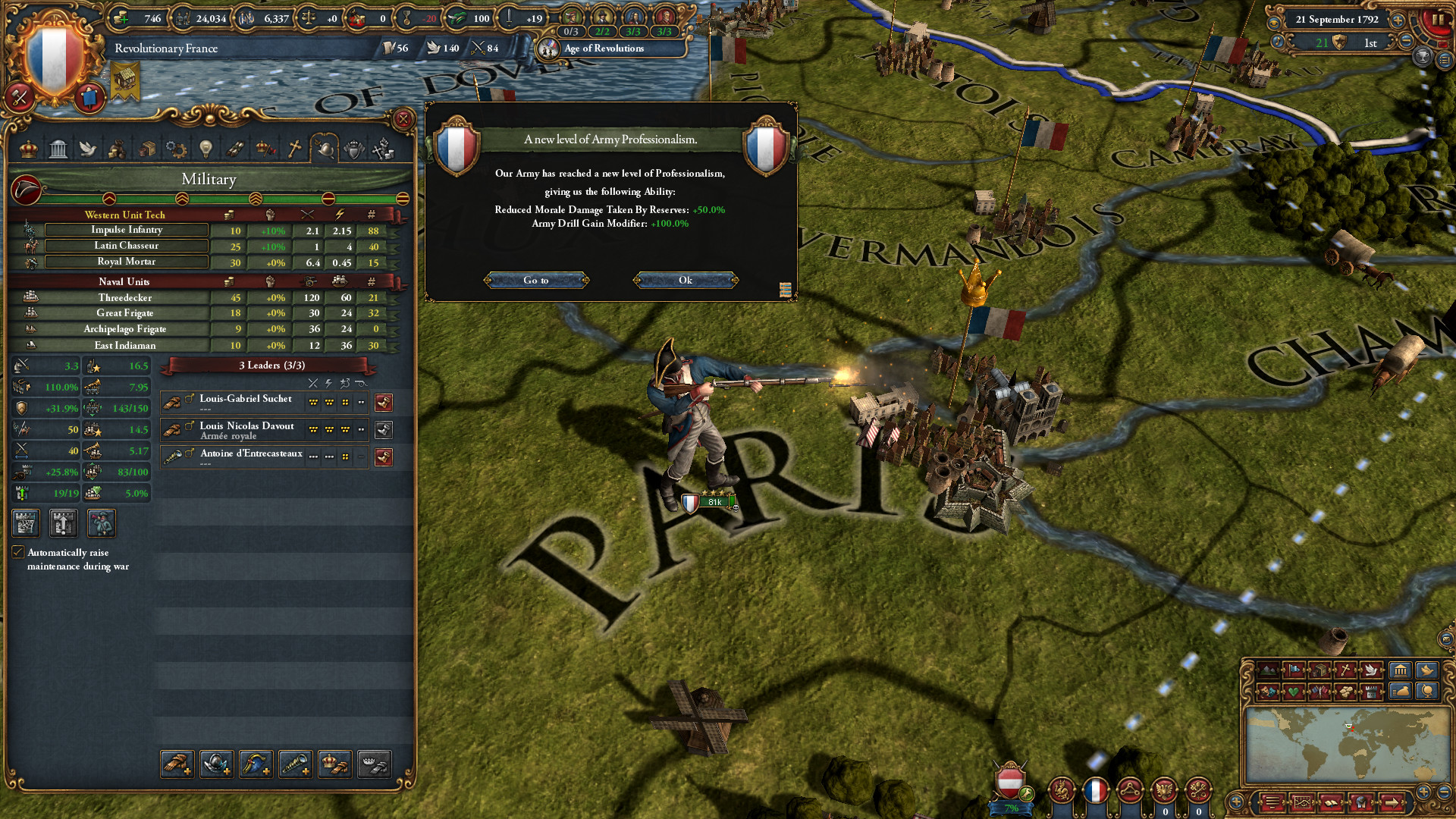
Army professionalism adds a deeper military layer, letting players drill troops, maintain discipline, and prepare forces that scale better in long campaigns. Warfare becomes less about raw numbers and more about preparation, timing, and sustaining armies that can survive prolonged conflicts across vast regions.
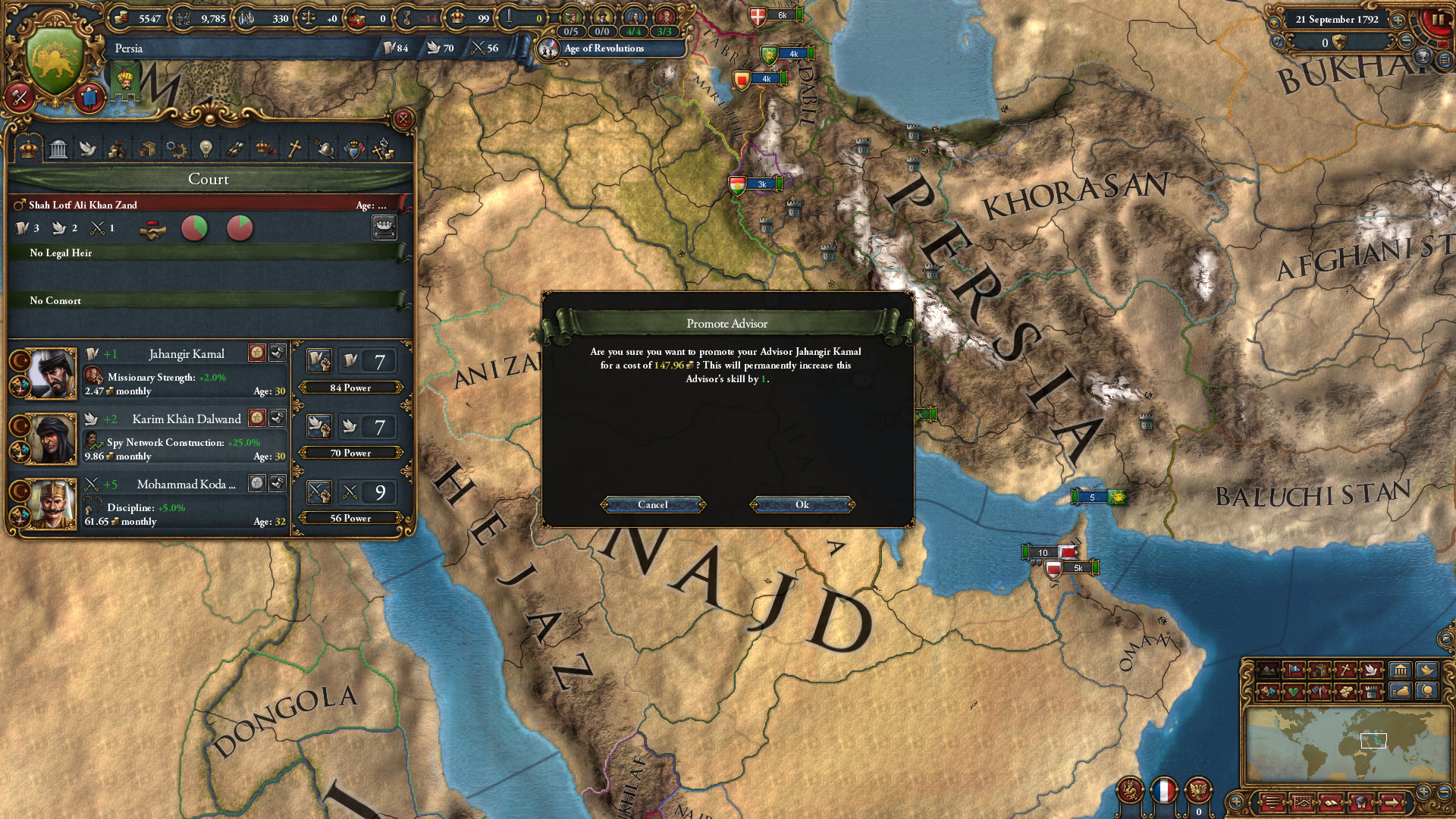
Estate systems shape internal politics, giving players tools to manage nobles, clergy, and merchants while balancing their demands for power and influence. These interactions affect taxes, manpower, and stability, making internal governance as important as external expansion in long-term strategy planning.
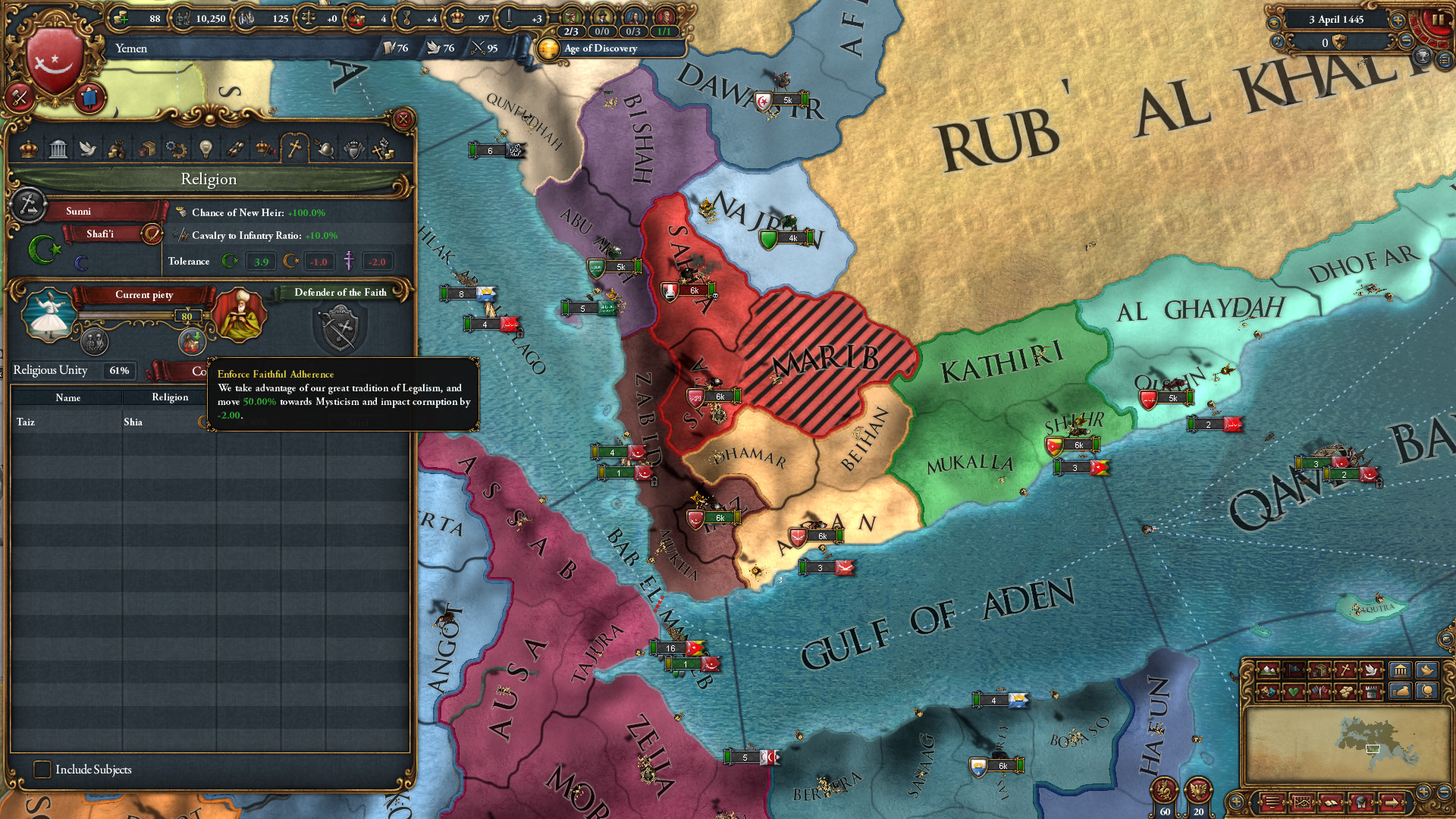
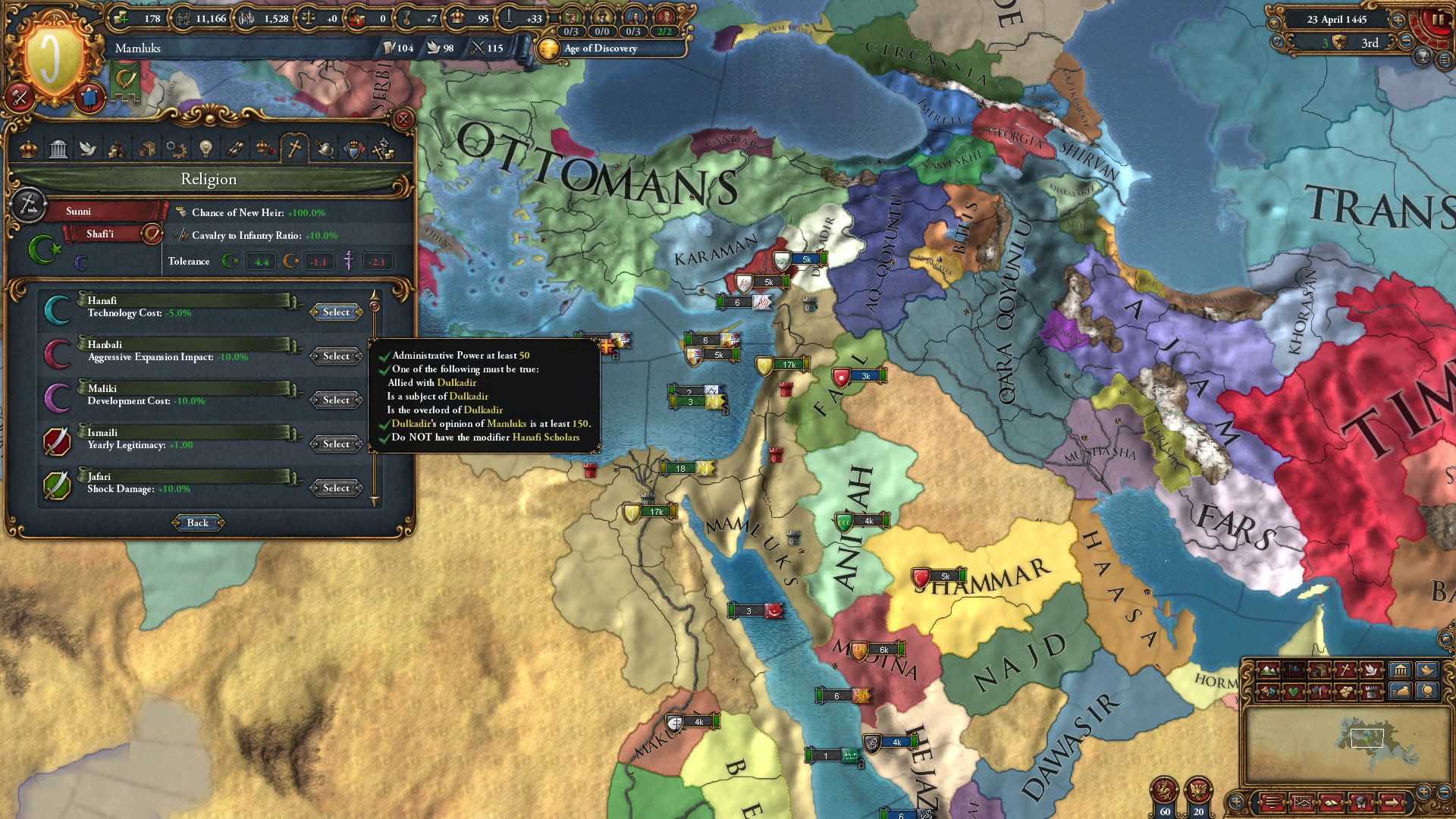
Religious mechanics for Islamic nations introduce piety and legalism, offering meaningful choices that influence military strength, taxation, and stability. This creates distinct playstyles depending on how players balance tradition, reform, and expansion within their chosen nation’s historical context.
Replayability comes from the sandbox design, where no two campaigns unfold the same way. Dynamic AI behavior, shifting alliances, and unpredictable wars ensure that every run offers new strategic challenges, encouraging experimentation with different nations and long-term planning approaches.
Cradle of Civilization stands out in the grand strategy genre by deepening regional identity and adding systems reward careful decision-making over time. It enhances the feeling of guiding a living historical world where every action has lasting consequences.
Gameplay
Europa Universalis IV: Cradle of Civilization builds on the grand strategy gameplay of Europa Universalis IV, where players control a nation and guide it through centuries of political, economic, and military change from 1444 onward. The core gameplay revolves around real-time decision-making on a global map, where every action influences diplomacy, warfare, and long-term national growth.
At its heart, the gameplay loop is about managing a country day by day while planning for decades ahead. Players expand territory through war or diplomacy, develop provinces, strengthen economies through trade networks, and maintain internal stability by balancing powerful estates. Each decision carries weight, and success depends on understanding how military strength, economic power, and political influence connect over time.
This expansion adds deeper systems that reshape how players interact with the world. Army professionalism becomes a key military layer, encouraging players to drill troops, maintain discipline, and build experienced armies instead of relying only on numbers. On the economic side, trade management in regions like the Middle East becomes more dynamic, allowing players to steer wealth across continents and control valuable trade routes.
Religious and cultural mechanics also play a stronger role in how nations evolve. Islamic nations, in particular, gain more nuanced systems such as piety and legalism, which influence governance, military effectiveness, and stability. These mechanics create different strategic paths depending on how players choose to rule and develop their empire.
Gameplay naturally evolves over time as nations grow stronger or weaker based on player choices, shifting alliances, and changing global conditions. There is no fixed path to victory, which encourages experimentation and replayability. Whether playing single-player campaigns or competing in multiplayer, every session unfolds differently, shaped by both strategy and unpredictability.
Cradle of Civilization ultimately deepens the grand strategy experience by adding more layers to planning, control, and adaptation, making each campaign feel like a long-form simulation of history driven by player decisions.
Story & World
Europa Universalis IV: Cradle of Civilization is set in a meticulously reconstructed early modern world where empires are not fixed destinies but fragile systems constantly being reshaped by ambition, belief, and survival. The game takes place across the Middle East, North Africa, and surrounding regions during the 15th to 18th centuries, a period defined by shifting power balances, expanding trade networks, and the rise and fall of great dynasties.
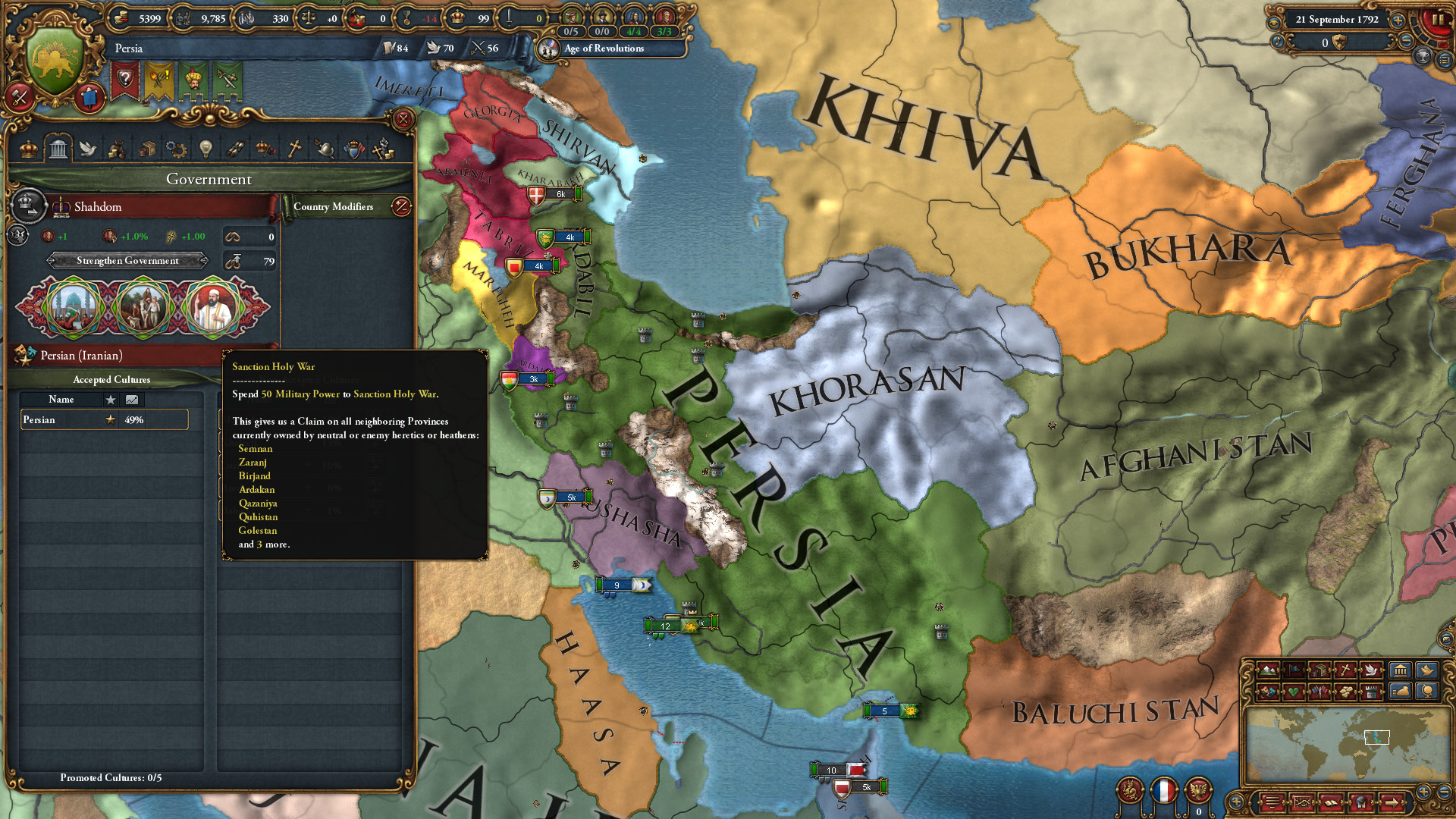
At the center of this world is a living political landscape where the Ottoman Empire pushes westward and eastward in search of dominance, while Persia rises as a cultural and military counterweight shaped by its own identity and internal transformation. In Egypt and the Levant, the remnants of older powers struggle to maintain control over trade routes and sacred cities, while the Arabian Peninsula connects distant regions through religion, commerce, and tribal influence. Each region feels distinct not only in geography but also in political character, economic importance, and historical tension.
Cradle of Civilization deepens this setting by giving greater texture to the Islamic world and its surrounding civilizations, making the region feel more reactive, diverse, and grounded in historical complexity. Instead of a single unified narrative, the world presents overlapping stories of trade empires, religious movements, and dynastic struggles that unfold simultaneously across vast distances. The Silk Road and Indian Ocean trade routes act as invisible threads tying these regions together, creating a sense of interconnected history where events in one area ripple outward into others.
The player enters this world as the ruler of a nation, but not as a predefined hero or central character. Instead, they are placed into a living historical simulation where leadership is defined by choices, priorities, and long-term vision. Whether guiding a rising empire or defending a smaller state from larger powers, the role is less about following a scripted story and more about writing one through interaction with a constantly changing world.
What makes this setting feel distinctive is its sense of scale and continuity. Borders are never permanent, alliances shift with changing interests, and cultural identities evolve over time rather than remaining static. Cities that begin as regional centers can grow into critical hubs of trade and influence, while once-dominant powers can fade if mismanaged or outmaneuvered. The world feels alive because it does not wait for the player; it moves forward with or without intervention.
The atmosphere is shaped by contrast between desert and river valley, between imperial ambition and local autonomy, between religious authority and political pragmatism. This creates a layered historical environment that feels both grounded and dynamic, where every region contributes to a larger global story of expansion and resistance.
In Cradle of Civilization, the world is not presented as a fixed backdrop but as a shifting stage of human history. It invites players to observe how cultures intersect, how empires rise under pressure, and how fragile even the strongest powers can be. Over time, this evolving geopolitical landscape becomes a personal map of decisions and consequences, making the experience feel like a slow unfolding chronicle of an era defined by change, conflict, and enduring transformation.
Game Modes
Europa Universalis IV: Cradle of Civilization expands the way players can experience grand strategy by shaping how campaigns unfold across both single-player and multiplayer settings, each offering a different rhythm of decision-making, pacing, and long-term planning.
In single-player mode, the experience is centered on sandbox-driven nation building. Players take control of a country and guide it through centuries of political change, territorial expansion, and economic development. This mode appeals to those who prefer thoughtful, slow-burn strategy where every action can reshape the global balance. The AI-controlled world reacts dynamically, meaning no two campaigns feel identical, even when playing the same nation again. It’s a reflective, strategic experience that rewards patience, experimentation, and long-term thinking.
Multiplayer mode shifts the focus toward competitive and cooperative grand strategy. Here, players share the same evolving world with others, forming alliances, negotiating trade agreements, or engaging in full-scale wars for dominance. The unpredictability of human decision-making adds tension and variety, making diplomacy and timing just as important as military strength. It’s best suited for players who enjoy social strategy, rivalry, and adapting plans on the fly as global conditions shift unexpectedly.
For players who prefer structured scenarios, custom campaigns allow for tailored experiences where nations, starting conditions, and objectives can be adjusted. This flexibility makes it easier to explore specific historical regions or test different strategic approaches without committing to a full long-term empire-building run. It’s a more controlled way to engage with the same deep systems at a different pace.
Across all modes, Cradle of Civilization enriches the experience by deepening regional dynamics, especially in the Middle East and surrounding areas, where trade, religion, and military development play a stronger role in shaping outcomes. Whether played solo or with others, the game consistently evolves based on decisions, ensuring that each session feels like part of a larger, unpredictable historical simulation rather than a fixed storyline.
Visuals & Art Style
Europa Universalis IV: Cradle of Civilization presents a visual style rooted in clarity and historical atmosphere rather than cinematic realism. The world is shown through a detailed top-down strategic map where geography, politics, and culture come together in a way that is both readable and expressive. At first glance, it feels like a living historical atlas, but as you spend time with it, the subtle visual layering begins to reveal depth terrain textures, shifting borders, and region-specific details that reflect centuries of change.
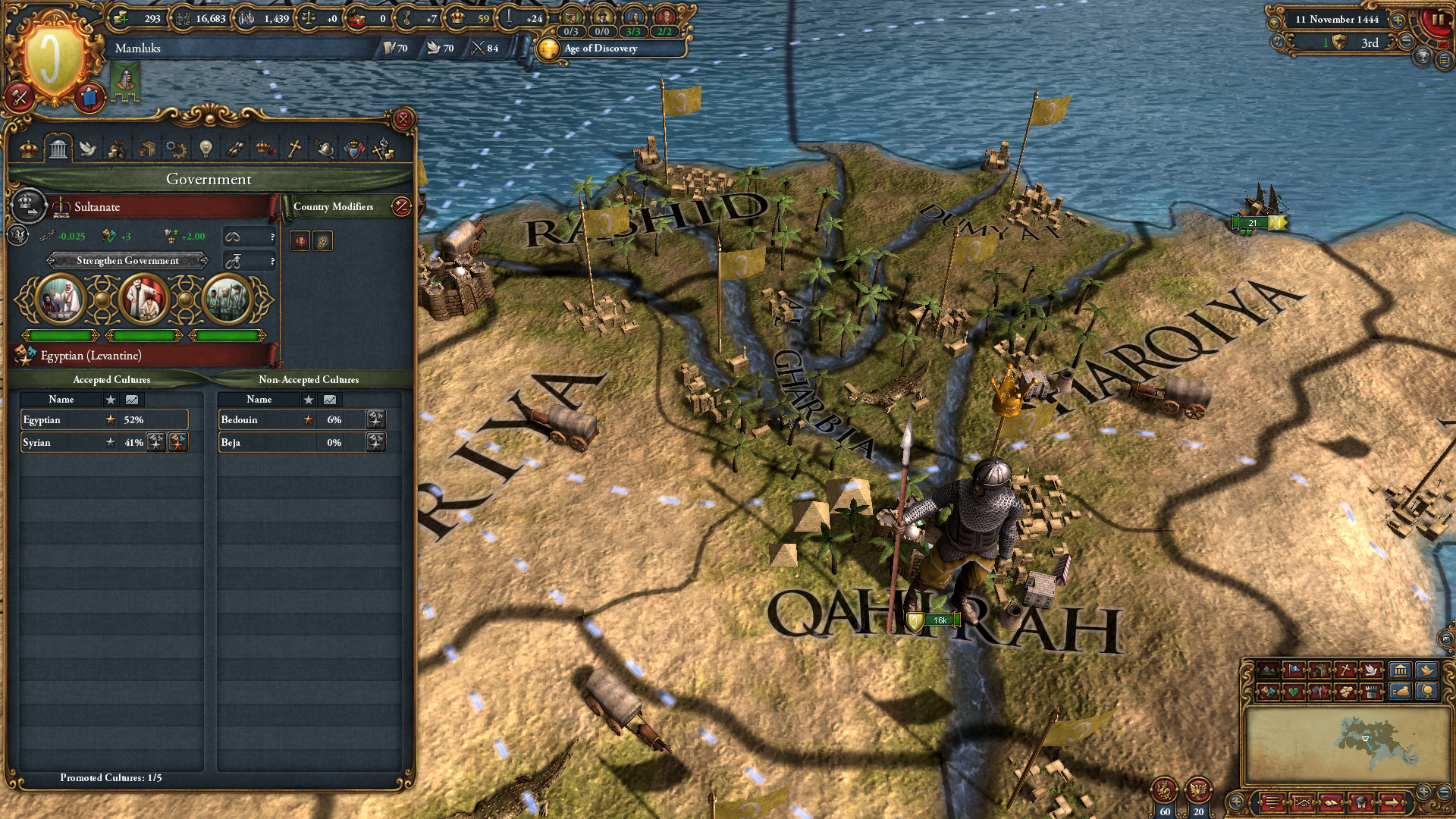
The art direction leans toward a clean, stylized presentation that prioritizes information without losing atmosphere. Deserts stretch in muted golds and soft browns across the Middle East, while river valleys like the Nile and Tigris-Euphrates glow with richer greens that naturally draw the eye toward centers of civilization. Cities are represented through evolving visual markers that grow more complex as nations develop, giving a quiet sense of progress without breaking immersion.
In Cradle of Civilization, regional identity is also reflected visually through cultural architecture styles, unit designs, and interface elements tied to Islamic and Middle Eastern aesthetics. These details are not overwhelming, but they add character to the world, helping each region feel distinct on the map. The visual language subtly communicates differences in power, development, and influence, making the political landscape easier to interpret at a glance.
Lighting and seasonal shifts add gentle variation over time, with softer tones during peaceful periods and more dramatic contrasts during conflict or instability. Battles unfold on simplified but readable terrain views where unit positioning and movement are clearly visible, keeping focus on strategy rather than spectacle.
What makes the visual approach stand out is its consistency with gameplay. Every visual element serves a purpose, whether guiding attention to trade hubs, highlighting territorial change, or reinforcing the scale of empire-building across centuries. Instead of overwhelming detail, the game relies on layered simplicity that slowly reveals its complexity as the player learns to read the world.
The result is a visual experience that feels calm, structured, and deeply immersive, supporting long campaigns where the evolving map itself becomes a record of history shaped by player decisions.
Technical Requirements
Europa Universalis IV: Cradle of Civilization is a PC-focused grand strategy DLC available through platforms like Steam on Windows, macOS, and Linux, running on top of the base Europa Universalis IV experience. Because it builds on an optimized strategy engine, system requirements remain relatively modest, making it accessible to both older laptops and modern gaming PCs. At a minimum, smooth gameplay runs on systems with a basic multi-core processor, 8 GB RAM, and integrated or entry-level dedicated graphics, while recommended setups with stronger CPUs and 16 GB RAM deliver faster AI processing, smoother late-game performance, and reduced wait times during large-scale wars and diplomacy shifts.
Performance is generally stable across a wide range of hardware, with the game scaling well from low to high-end systems. On stronger PCs, especially those with modern CPUs, turn progression and map updates feel noticeably faster during late-game periods when empires expand and calculations increase. Resolution support is flexible, including ultrawide displays, and UI scaling helps maintain readability during long campaigns spanning centuries.
Controls are designed primarily around keyboard and mouse input, allowing precise map navigation, quick menu access, and efficient management of complex systems like trade, diplomacy, and warfare. While controller support is not a focus, full key remapping is available, giving experienced players the ability to customize shortcuts for faster strategic decision-making.
Accessibility options include scalable interface elements, adjustable text sizes, and visual clarity settings that help reduce strain during extended play sessions. Tooltips and contextual guidance make it easier for players to understand mechanics without overwhelming menus. Audio cues and clear visual indicators support readability during fast-changing political or military situations.
Cradle of Civilization maintains a lightweight yet deep technical profile as Europa Universalis IV, ensuring players can focus more on strategy and less on hardware limitations while experiencing a large-scale historical simulation.
Who Is This Game For?
Europa Universalis IV: Cradle of Civilization is best suited for players who enjoy slow-burn strategy experiences where decisions matter more over time than instant action. It appeals strongly to fans of grand strategy and historical simulation games who like thinking several steps ahead, managing complex systems, and watching long-term consequences unfold across centuries. If you enjoy games where you control entire nations rather than individual characters, this DLC naturally fits that mindset.
Players who are drawn to deep planning, economic management, and political strategy will find a lot to engage with here. Much of the experience revolves around shaping trade networks, guiding diplomacy, and balancing internal stability while expanding influence across a dynamic world map. It rewards patience and curiosity, especially for those who like experimenting with different nations and alternate historical outcomes. The added regional depth in the Middle East makes it particularly appealing to players interested in historically rich settings and culturally diverse empires.
It also works well for players who enjoy sandbox-style freedom in single-player campaigns, where there is no fixed storyline and every run develops differently based on choices and global events. In multiplayer, it becomes more competitive and unpredictable, attracting players who enjoy negotiation, rivalry, and adapting strategy against real human opponents.
However, it may feel overwhelming for players who prefer fast-paced action, short sessions, or clearly guided progression systems. The learning curve is gradual, and the systems are layered, so it demands attention and a willingness to experiment rather than immediate mastery. That said, many players find the depth rewarding once they become comfortable with its rhythm.
Overall, Cradle of Civilization is designed for strategy-focused players who value depth, replayability, and long-form decision-making over quick wins. It’s a good match for those who enjoy building and shaping history at their own pace, where every campaign becomes a unique story shaped by patience, planning, and adaptability.
FAQ
What kind of game is Europa Universalis IV: Cradle of Civilization?
It is a grand strategy expansion that builds on Europa Universalis IV, focusing on nation management, diplomacy, trade, and long-term historical simulation. You play as a country ruler guiding an empire through centuries of political and economic change.
Who is this DLC best suited for?
It’s ideal for players who enjoy deep strategy games, slow decision-making, and long campaigns. If you like thinking ahead, managing systems like trade and politics, and shaping alternate history, this expansion fits that playstyle well.
Can I play it solo or with others?
Yes, it supports both single-player and multiplayer. Single-player offers a relaxed sandbox experience against AI nations, while multiplayer introduces more unpredictable, competitive diplomacy and player-driven conflict.
What does the gameplay actually involve?
Most of your time is spent expanding territory, managing internal estates, building armies, negotiating alliances, and controlling trade routes. The DLC adds more depth to regional systems, especially in Middle Eastern nations, making each campaign feel more distinct.
Is it beginner-friendly or hardcore?
It leans more toward hardcore strategy, but patient newcomers can still enjoy it. The systems are complex, but the learning curve becomes manageable over time with experimentation.
What platforms does it support?
It runs on PC through Steam and is compatible with Windows, macOS, and Linux as part of Europa Universalis IV.
Does it require high-end hardware?
No. It runs on a wide range of systems. Even mid-range or older PCs can handle it, though faster CPUs improve late-game performance.
Is it replayable?
Yes, highly replayable. Every campaign unfolds differently due to dynamic AI behavior, shifting alliances, and sandbox-style freedom.
Does it require online connection?
Single-player works offline, but multiplayer requires an internet connection.
FAQ
Operating System (OS)
Other Details

Languages



Reviews
There are no reviews yet.