

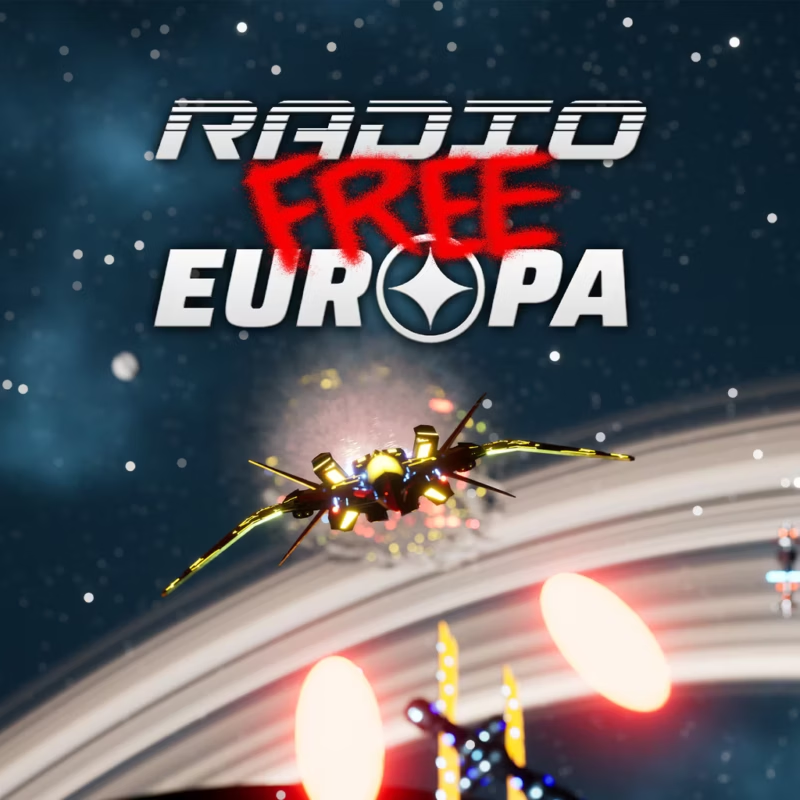
Radio Free Europa Steam CD Key
10 in stock
Sold by: OMG Gamer






Delivery24/7
supportVerified
Sellers

Product Description
Radio Free Europa Steam CD Key
Quck Intro
Radio Free Europa is a narrative-driven experience that places players in a tense, information-scarce world where communication becomes both a tool and a risk. Set against a backdrop of fractured European states and rising control over media, the game focuses on uncovering truth through intercepted broadcasts, coded signals, and fragmented stories. Players take on the role of an operator working with limited resources, piecing together intelligence while deciding what information to trust or suppress. The gameplay blends exploration, decision-making, and light strategy, creating a slow-burn experience where every choice can influence how events unfold. What makes it stand out is its focus on radio-based storytelling and atmosphere, where sound design and dialogue carry as much weight as visuals. Designed for players who enjoy immersive indie narratives, it emphasizes tension, curiosity, and interpretation over direct action.
About
Radio Free Europa is a narrative-driven espionage and communication strategy game set in a fragmented modern Europe where information is tightly controlled and truth is often hidden in static. Players step into the role of a radio operator working within an underground network, using intercepted broadcasts, encrypted signals, and fragmented transmissions to piece together what is really happening across shifting political borders. The experience is grounded in tension and uncertainty, where listening carefully is just as important as acting quickly.
The core gameplay loop revolves around monitoring radio frequencies, decoding messages, and deciding how to respond to incoming intelligence. Each in-game day presents new transmissions, branching story threads, and conflicting reports that require interpretation rather than simple answers. Players manage limited communication tools, prioritize which signals to investigate, and shape outcomes through dialogue choices and strategic information sharing. Progression comes through expanding your network, unlocking stronger decoding capabilities, and gaining access to deeper layers of hidden broadcasts.
What sets Radio Free Europa apart is its focus on sound-driven storytelling and player interpretation. Instead of traditional combat or fast-paced action, the game builds its tension through atmosphere, radio chatter, and the weight of incomplete information. Every message can change your understanding of the world, making observation and judgment central to the experience. The branching narrative structure ensures that decisions carry consequences, encouraging replayability and experimentation with different approaches to truth-seeking.
This is a game designed for players who enjoy story-rich experiences, slow-burn strategy, and investigative gameplay. Fans of narrative adventures, immersive sims, and decision-based systems will find a familiar but distinct rhythm here, where patience and attention to detail matter more than reflexes. It appeals to those who like unraveling complex stories at their own pace, especially in settings shaped by political intrigue and uncertainty.
Radio Free Europa ultimately offers a reflective and immersive journey into the fragile nature of communication, where every signal might be a clue or a deception. It invites players to listen closely, think critically, and decide what truth they are willing to act on in a world where silence can be just as powerful as sound.
Key Features
Radio Free Europa centers on a tense, radio-driven gameplay loop where players listen, interpret, and act on fragmented transmissions coming from across a divided Europe. Each session revolves around scanning frequencies, catching coded messages, and deciding which signals are worth pursuing, creating a constant cycle of attention, analysis, and response that keeps the experience grounded in observation rather than action-heavy gameplay.
Players work as an underground operator managing a growing network of contacts, where every intercepted broadcast may contain intelligence, misinformation, or partial truths. Decoding tools evolve over time, allowing deeper analysis of encrypted chatter and expanding the range of accessible channels. The progression system is tied to how effectively you build trust within your network and how accurately you interpret incomplete information.
The world is designed around uncertainty, with shifting political regions, unstable communication lines, and overlapping narratives that change based on player decisions. Instead of a linear story, events unfold through radio segments and dialogue fragments, encouraging players to piece together meaning from limited data. Exploration happens through sound rather than movement, making listening itself the primary form of discovery.
Choice and consequence are central to the experience. Decisions about which signals to prioritize, which factions to assist, and what information to relay directly influence how the broader story develops. This creates a branching structure where outcomes are shaped by interpretation as much as action, offering strong replay value for players who want to explore different narrative paths.
The game emphasizes strategic thinking and patience, appealing to players who enjoy narrative strategy games, immersive simulators, and investigative storytelling. There is no traditional combat system; instead, tension is built through time pressure, incomplete intelligence, and the risk of miscommunication in a world where every broadcast matters.
Designed for PC and narrative-focused platforms, Radio Free Europa delivers an atmospheric experience where sound design, dialogue, and player judgment form the core gameplay pillars. It is a slow-burning, choice-driven experience built for players who enjoy uncovering stories piece by piece and shaping outcomes through careful listening rather than direct confrontation.
Gameplay
Radio Free Europa is set in a fractured near-future Europe where borders have become unstable, governments have splintered into competing blocs, and control over information is more valuable than territorial power. The world is shaped less by open warfare and more by quiet influence, where broadcasts, rumors, and encrypted signals determine how entire regions understand reality. In this environment, truth is not openly shared it is transmitted, distorted, and often lost in interference.
The player steps into the role of a remote radio operator working for an underground communication network that exists outside official state systems. This role is not defined by combat or frontline action, but by distance, observation, and interpretation. From a hidden station surrounded by static-filled equipment and outdated tech, you listen to the fragmented voice of a continent trying to speak through controlled airwaves. Every transmission you receive is part of a larger, shifting narrative that reflects political unrest, civilian resistance, and the quiet collapse of trust between regions.
Europe itself is presented as a layered and atmospheric open narrative space rather than a traditional map. Different territories carry their own tone and identity industrial corridors where state propaganda dominates the airwaves, rural zones where rogue signals pass freely between makeshift transmitters, and urban centers where competing factions fight for control of digital and analog communication channels. These regions are not just backdrops, but evolving systems of influence, each contributing pieces to a larger, incomplete picture of what is happening across the continent.
At the center of this world is a constant tension between information and interpretation. The story unfolds through intercepted conversations, emergency broadcasts, and coded messages that often contradict each other. Rather than presenting a single, fixed narrative, Radio Free Europa allows the player to assemble meaning from fragments, gradually revealing how different factions shape events through selective communication. Some voices demand help, others attempt manipulation, and many exist in moral grey areas where intent is unclear.
The atmosphere of the game leans heavily into realism and psychological tension. Silence is as important as sound, and what is left unsaid often carries more weight than what is clearly transmitted. The world feels alive not through constant action, but through the sense that something is always happening just beyond the range of your frequency, waiting to be tuned in at the right moment.
As the operator, the player becomes a quiet but influential presence within this unstable network of communication. You are not a hero on the battlefield, but a witness positioned at the intersection of multiple truths. Decisions made through listening and interpretation subtly reshape how factions perceive one another, influencing alliances, misunderstandings, and the broader direction of the unfolding crisis.
Radio Free Europa builds its identity around ambiguity, atmosphere, and narrative discovery. It invites players into a world where understanding is never complete, and every signal carries the potential to change how the continent is seen and how it sees itself.
Story & World
Radio Free Europa is primarily a single-player narrative experience, designed around different ways of engaging with its radio-driven storytelling system, rather than traditional match-based or multiplayer modes. At its core is the main campaign mode, where players progress through a structured but branching narrative shaped by intercepted broadcasts, evolving political tensions, and shifting alliances across a fractured Europe. This is where the central story unfolds in full, and where most players will first learn how to interpret signals, manage uncertainty, and make decisions that ripple across the wider world.
Alongside the campaign, the game introduces a more open-ended broadcast mode that focuses on emergent storytelling through procedural transmissions. In this experience, players are not following a fixed narrative path but instead responding to continuously changing radio traffic that simulates ongoing events across the continent. It is a slower, more reflective way to play, ideal for those who enjoy immersive simulation-style gameplay and want to experiment with different interpretations of fragmented information without the pressure of structured story progression.
For players who prefer focused challenges, Radio Free Europa also offers scenario-based sessions built around specific communication crises. These compact experiences test how efficiently players can decode signals, prioritize conflicting reports, and reach outcomes under time-sensitive conditions. Each scenario is designed to highlight a different aspect of the game’s core systems, such as misinformation detection, network management, or high-pressure decision-making.
Across all modes, the experience remains grounded in listening, analysis, and choice-driven narrative design. There is no shift away from the core identity of the game, but rather different pacing options that allow players to engage with its world in multiple ways. Whether following the main story, exploring dynamic broadcasts, or tackling focused scenarios, each mode reinforces the same central idea: understanding a fractured world through incomplete information.
This structure gives Radio Free Europa strong replay value, as different modes encourage new interpretations of the same unstable geopolitical landscape, making each session feel distinct while staying rooted in its atmospheric, story-first design.
Game Modes
Radio Free Europa is primarily a single-player narrative experience, designed around different ways of engaging with its radio-driven storytelling system, rather than traditional match-based or multiplayer modes. At its core is the main campaign mode, where players progress through a structured but branching narrative shaped by intercepted broadcasts, evolving political tensions, and shifting alliances across a fractured Europe. This is where the central story unfolds in full, and where most players will first learn how to interpret signals, manage uncertainty, and make decisions that ripple across the wider world.
Alongside the campaign, the game introduces a more open-ended broadcast mode that focuses on emergent storytelling through procedural transmissions. In this experience, players are not following a fixed narrative path but instead responding to continuously changing radio traffic that simulates ongoing events across the continent. It is a slower, more reflective way to play, ideal for those who enjoy immersive simulation-style gameplay and want to experiment with different interpretations of fragmented information without the pressure of structured story progression.
For players who prefer focused challenges, Radio Free Europa also offers scenario-based sessions built around specific communication crises. These compact experiences test how efficiently players can decode signals, prioritize conflicting reports, and reach outcomes under time-sensitive conditions. Each scenario is designed to highlight a different aspect of the game’s core systems, such as misinformation detection, network management, or high-pressure decision-making.
Across all modes, the experience remains grounded in listening, analysis, and choice-driven narrative design. There is no shift away from the core identity of the game, but rather different pacing options that allow players to engage with its world in multiple ways. Whether following the main story, exploring dynamic broadcasts, or tackling focused scenarios, each mode reinforces the same central idea: understanding a fractured world through incomplete information.
This structure gives Radio Free Europa strong replay value, as different modes encourage new interpretations of the same unstable geopolitical landscape, making each session feel distinct while staying rooted in its atmospheric, story-first design.
Visuals & Art Style
Radio Free Europa presents a visual identity shaped by restraint, tension, and atmosphere rather than spectacle. The world is framed through a grounded, semi-realistic art style that leans heavily on muted tones, grainy textures, and controlled lighting. Instead of bright color palettes or high-energy visual effects, the game uses desaturated blues, faded greys, and warm analog glows to reflect a Europe defined by uncertainty and fragmented communication. This approach immediately sets a serious, investigative tone that aligns with the radio-based storytelling at its core.
Environments are detailed in a way that feels lived-in but intentionally incomplete, as if always partially obscured by distance or signal loss. Abandoned relay stations, dimly lit control rooms, and weathered urban edges are presented with subtle environmental storytelling rather than overt exposition. Small visual cues flickering monitors, handwritten notes, static-filled screens help communicate narrative context without breaking immersion. The result is a world that feels constantly in transition, as though it is being pieced together in real time.
Character design follows a similarly grounded philosophy. Figures are not exaggerated or stylized for effect, but instead reflect ordinary individuals operating under extraordinary pressure. Their presence is often communicated through silhouette, lighting contrast, or partial visibility over radio feeds and surveillance-style interfaces, reinforcing the idea that most connections in the game are indirect and mediated through technology.
Lighting plays a central role in shaping the experience. Soft, directional light sources contrast with heavy shadows, creating a sense of isolation and focus. Interface elements are integrated into the environment itself, blending physical equipment with digital overlays in a way that feels functional rather than decorative. This fusion of analog and digital aesthetics strengthens the game’s core theme of outdated systems carrying urgent information.
What makes Radio Free Europa visually distinctive is how consistently its art direction supports its narrative tension. Nothing feels overly polished or exaggerated; instead, every visual choice reinforces distance, ambiguity, and interpretation. It is a world where clarity is rare, and the visuals reflect that uncertainty at every turn, drawing players deeper into its quiet, signal-driven atmosphere.
Technical Requirements
Radio Free Europa is designed primarily for PC players, with a strong focus on scalable performance so it can run smoothly across a wide range of systems. On Windows PCs, the game is built to perform well on modest hardware while taking advantage of higher-end rigs for improved visual clarity, faster loading, and more stable frame rates. Minimum system expectations generally include a modern quad-core processor, 8 GB RAM, and an entry-level dedicated GPU, which allows the game to run at lower settings with stable performance. For a smoother experience, especially at higher resolutions and enhanced visual effects, a mid-range CPU, 16 GB RAM, and a modern mid-tier GPU are recommended. Linux builds are also supported through compatible distributions, offering similar performance scaling depending on system configuration.
The game is optimized to maintain consistent frame pacing, even during heavier narrative sequences with layered audio and real-time signal processing. Load times are kept short through efficient asset streaming, making transitions between sessions and radio segments feel seamless rather than disruptive. On higher-end systems, players can expect improved lighting fidelity, sharper environmental detail, and higher resolution support, including ultrawide displays.
Radio Free Europa is also planned for major console platforms, where controls are adapted for gamepad-first interaction without losing precision in signal navigation or decision-making systems. Whether using keyboard and mouse or a controller, input feels responsive and intuitive, with full remapping options available to tailor the experience. The interface is designed to work equally well across both input styles, ensuring accessibility without complexity.
Accessibility has been considered throughout the experience, with support for subtitles, scalable text options, and audio balancing tools that help emphasize critical radio transmissions. Visual settings allow players to adjust contrast, interface clarity, and motion intensity to suit different comfort levels. Difficulty is more about pacing and information pressure rather than traditional challenge settings, allowing players to engage at a rhythm that fits their preference.
Across all platforms and configurations, Radio Free Europa focuses on delivering a stable, readable, and atmospheric experience. Whether played on a high-end gaming PC or a more modest setup, the core experience of decoding signals, interpreting broadcasts, and navigating uncertainty remains intact and responsive.
Who Is This Game For?
Radio Free Europa is best suited for players who enjoy slow-burn, narrative-heavy experiences where observation and interpretation matter more than fast reflexes. If you’re someone who likes story-driven games, investigative gameplay, or immersive simulations that ask you to think carefully before acting, this is a strong fit. The game rewards patience, attention to detail, and curiosity, especially for players who enjoy piecing together fragmented information and forming their own understanding of events rather than being given direct answers.
It will particularly appeal to fans of atmospheric single-player experiences where worldbuilding is delivered through dialogue, environmental cues, and audio design rather than constant action or cinematic set pieces. Players who enjoy managing systems, analyzing clues, or engaging with decision-based progression will find the core loop of monitoring transmissions and decoding messages engaging over long sessions. There is a strong emphasis on replayability as well, since different choices and interpretations of information can lead to noticeably different narrative outcomes.
This game also suits players who appreciate slower pacing and don’t mind ambiguity in storytelling. Much of the experience is about uncertainty, where not every signal has a clear meaning and not every decision has an obvious “right” answer. That makes it rewarding for those who enjoy reflective gameplay, but it may feel less suitable for players who prefer constant action, competitive multiplayer environments, or highly structured mission-based progression.
If you are drawn to fast-paced shooters, highly directive storytelling, or games that constantly guide you toward clear objectives, Radio Free Europa may feel deliberately restrained in comparison. It does not rely on traditional combat systems or high-intensity mechanics, and instead focuses on atmosphere, interpretation, and narrative depth.
For the right audience, however, it offers a distinctive kind of engagement one where listening becomes gameplay, uncertainty becomes tension, and every small piece of information feels meaningful. It is a game for players who enjoy thinking their way through a world rather than simply moving through it.
FAQ
What kind of game is Radio Free Europa?
Radio Free Europa is a narrative-driven, radio-based espionage and interpretation game. Instead of traditional combat, it focuses on listening to transmissions, decoding fragmented messages, and making decisions based on incomplete information in a tense, political near-future Europe.
Is it single-player or multiplayer?
The game is designed as a single-player experience. It is built around personal decision-making, story interpretation, and immersive solo gameplay rather than competitive or cooperative multiplayer modes.
What is the core gameplay experience like?
Players spend most of their time monitoring radio frequencies, analyzing intercepted broadcasts, and choosing how to respond to emerging events. The experience is slow-paced, thoughtful, and focused on reading between the lines of what is heard rather than what is directly shown.
Which platforms is it available on?
Radio Free Europa is primarily developed for PC, with support for both Windows and Linux systems. It is also planned for major console platforms, offering adapted controls for gamepad users while keeping the core experience consistent.
What are the system requirements like?
The game is optimized to run on a wide range of PCs. It performs well on mid-range systems, and lower-end hardware can still run it at reduced settings. Higher-end PCs will benefit from improved visuals and smoother performance.
How long is the game and does it have replay value?
The campaign offers a multi-hour narrative experience, with branching choices that significantly affect outcomes. Replay value comes from different interpretations of information and alternative decision paths.
Is it suitable for casual players?
Yes, but it is best suited for players who enjoy slower, story-focused gameplay. It may not appeal to those looking for fast action or competitive mechanics.
Does it require an internet connection?
No, the core experience is fully playable offline as a single-player game.
FAQ
Operating System (OS)
Other Details
Release Date
Publishers
Developers
Age rating

Languages



Reviews
There are no reviews yet.