

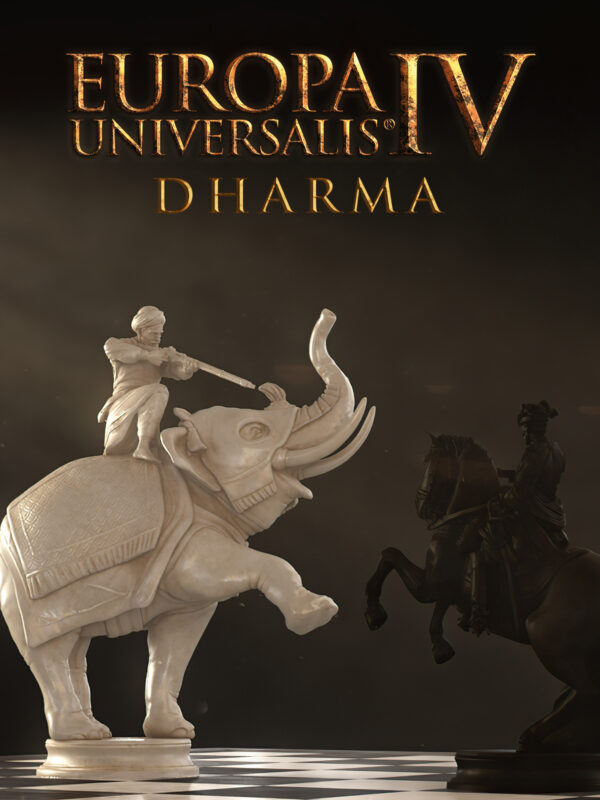
Europa Universalis IV – Dharma DLC PC Steam CD Key
35 in stock
copies left35 in stock
Sold by: OMG Gamer






Delivery24/7
supportVerified
Sellers

Product Description
Europa Universalis IV – Dharma DLC PC Steam CD Key
Quck Intro
Europa Universalis IV: Dharma expands the grand strategy experience by shifting focus toward the rich and complex political landscape of the Indian subcontinent. Set during the early modern era, it allows players to guide nations through diplomacy, warfare, and trade while managing evolving internal systems. The DLC introduces deeper estate mechanics, giving more control over powerful social classes that influence stability and development. Players can also explore expanded government reforms and new ways to shape their nation’s identity over time. Trade routes, regional conflicts, and colonial pressures add layers of strategic decision-making that reward careful long-term planning. Built for players who enjoy historical simulation and empire management, Dharma blends economic depth with political nuance, offering a more detailed and immersive approach to one of the most dynamic regions in Europa Universalis IV.
About
Europa Universalis IV: Dharma is a grand strategy expansion that deepens the political and economic simulation of early modern India within the broader world of global empire-building. Built for players who enjoy historical strategy games, it places you in control of nations navigating diplomacy, war, trade, and internal reform during a time of shifting power. The experience is less about fast action and more about long-term thinking, where every decision can reshape the future of your realm.
In Dharma, the core gameplay loop revolves around managing a growing state while balancing external expansion and internal stability. You’ll spend your time negotiating alliances, controlling trade networks, developing provinces, and responding to the demands of powerful social estates. Each campaign unfolds differently depending on how you choose to expand influence or secure loyalty within your borders, creating a layered sandbox of political strategy and nation management.
What sets this expansion apart from other strategy DLCs is its focus on regional depth and governance systems that feel alive and reactive. The estate mechanics add a new dimension to internal politics, while expanded government reforms let players define how their empire evolves over centuries. Combined with the rich trade routes and constant regional conflicts, it creates a more nuanced and immersive layer of decision-making than standard empire simulators.
This is a game for strategy enthusiasts, history fans, and players who enjoy slow-burn progression rather than instant rewards. Whether you prefer building a trading powerhouse, forging a military empire, or carefully balancing diplomacy, Dharma supports a wide range of playstyles grounded in thoughtful planning and adaptability.
Every session becomes a story of shifting alliances and rising ambition, where small choices can echo across centuries. Europa Universalis IV: Dharma invites you to step into a living historical world and shape it with patience, strategy, and intent.
Key Features
Europa Universalis IV: Dharma expands the grand strategy gameplay by giving players deeper control over nations in the Indian subcontinent during the early modern period. It blends political simulation, economic planning, and territorial expansion into a single long-form strategy experience where every decision influences centuries of history.
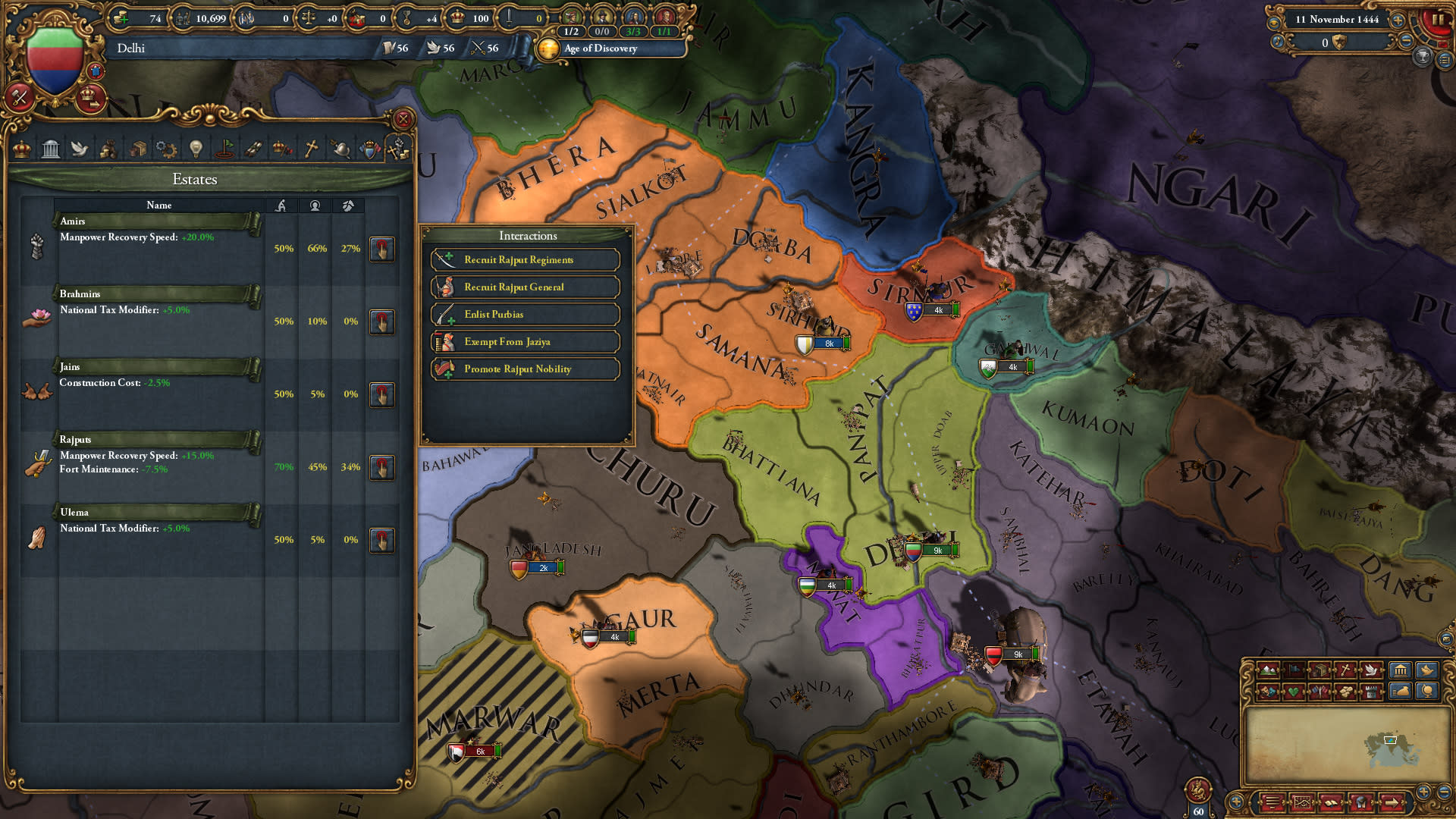
Players take charge of managing a nation through diplomacy, warfare, and internal governance, with a stronger focus on balancing power between rulers and influential estate groups. These estates shape laws, stability, and resource control, forcing you to constantly adjust strategy based on shifting internal demands rather than only external threats.
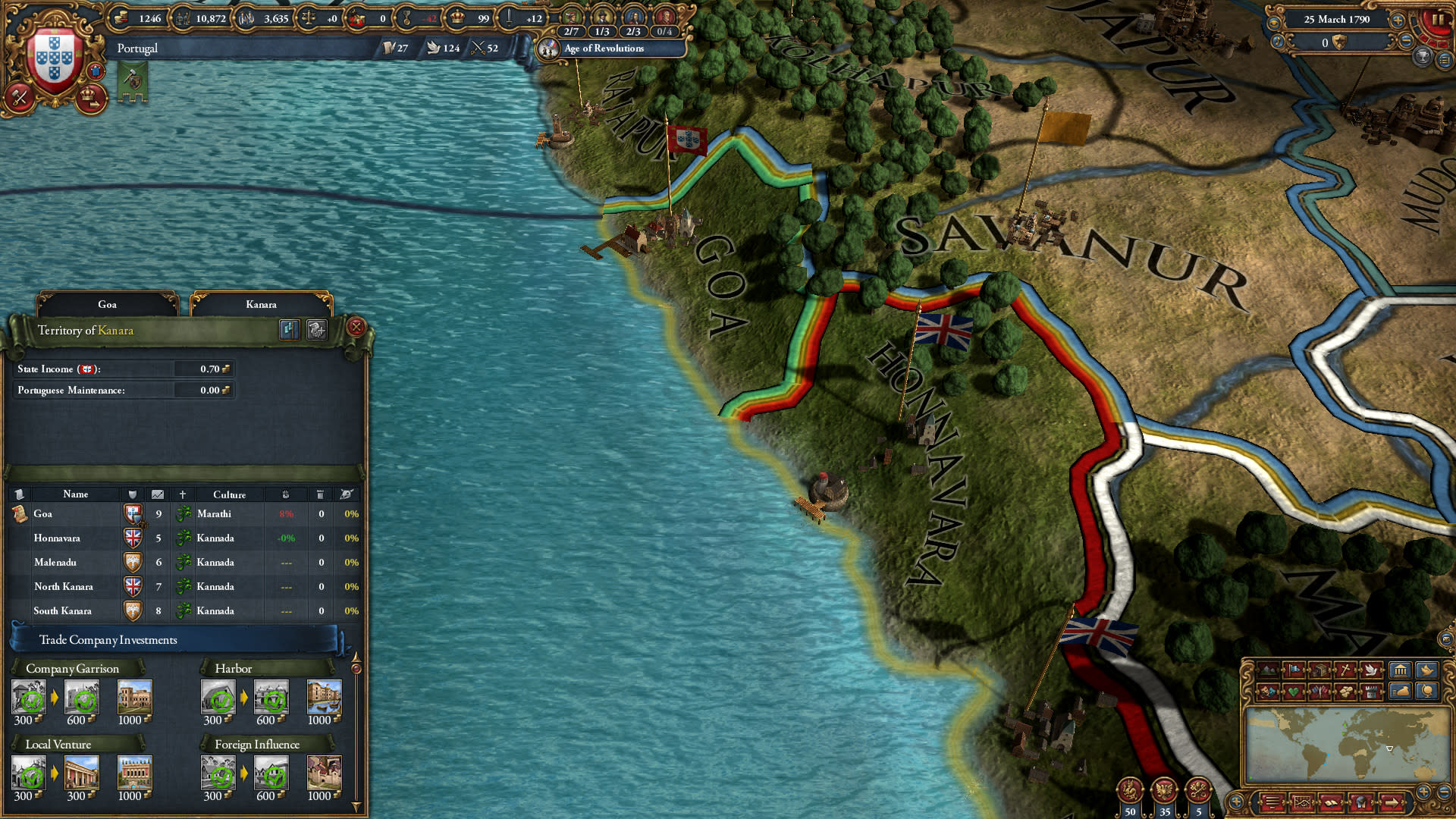
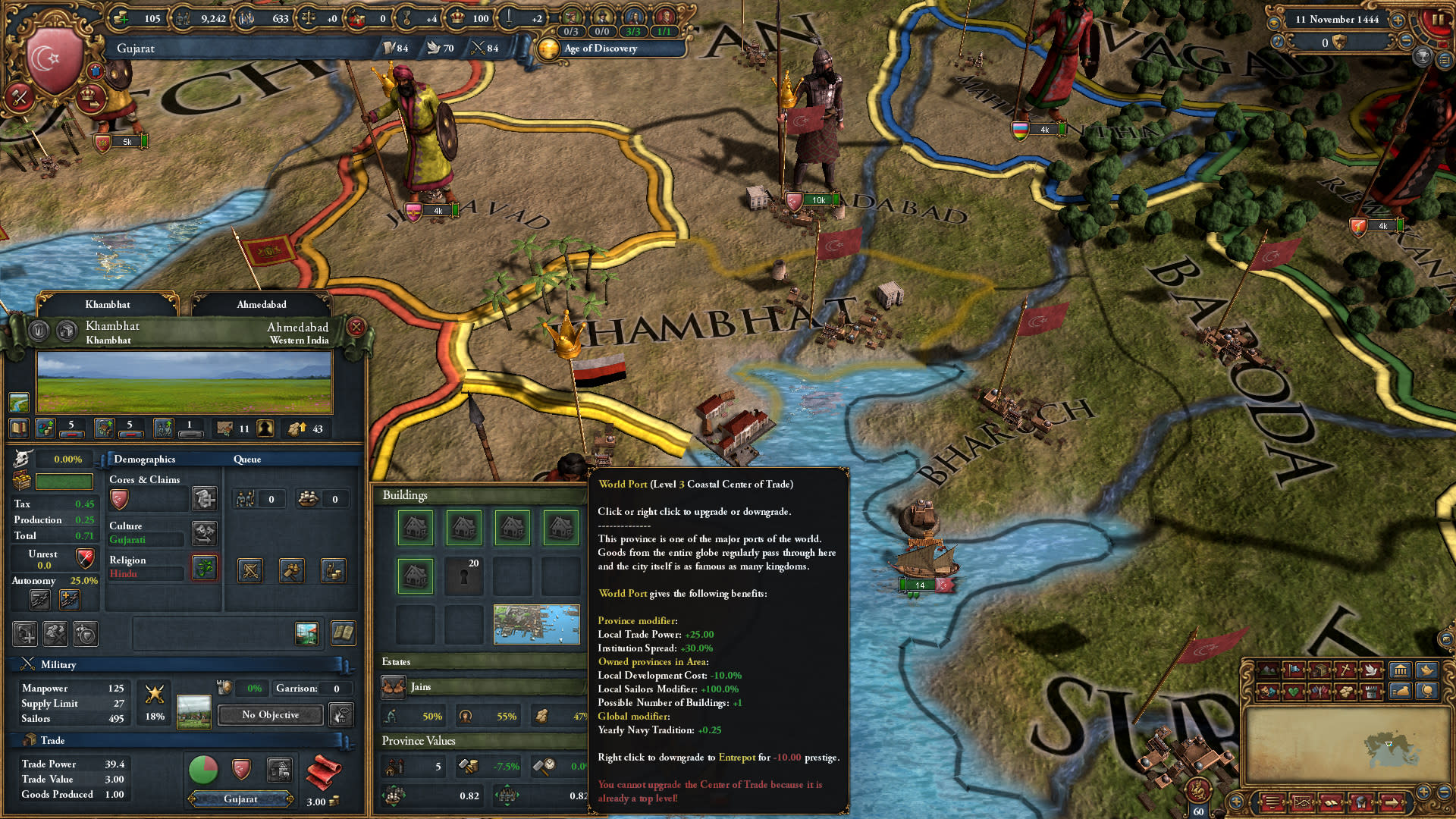
The expansion enhances the core gameplay loop of building an empire by improving how trade networks function across regions. Players can redirect wealth through strategic trade routes, strengthen provincial economies, and compete for dominance in one of the most dynamic commercial landscapes in the game world. Economic planning becomes just as important as military conquest.
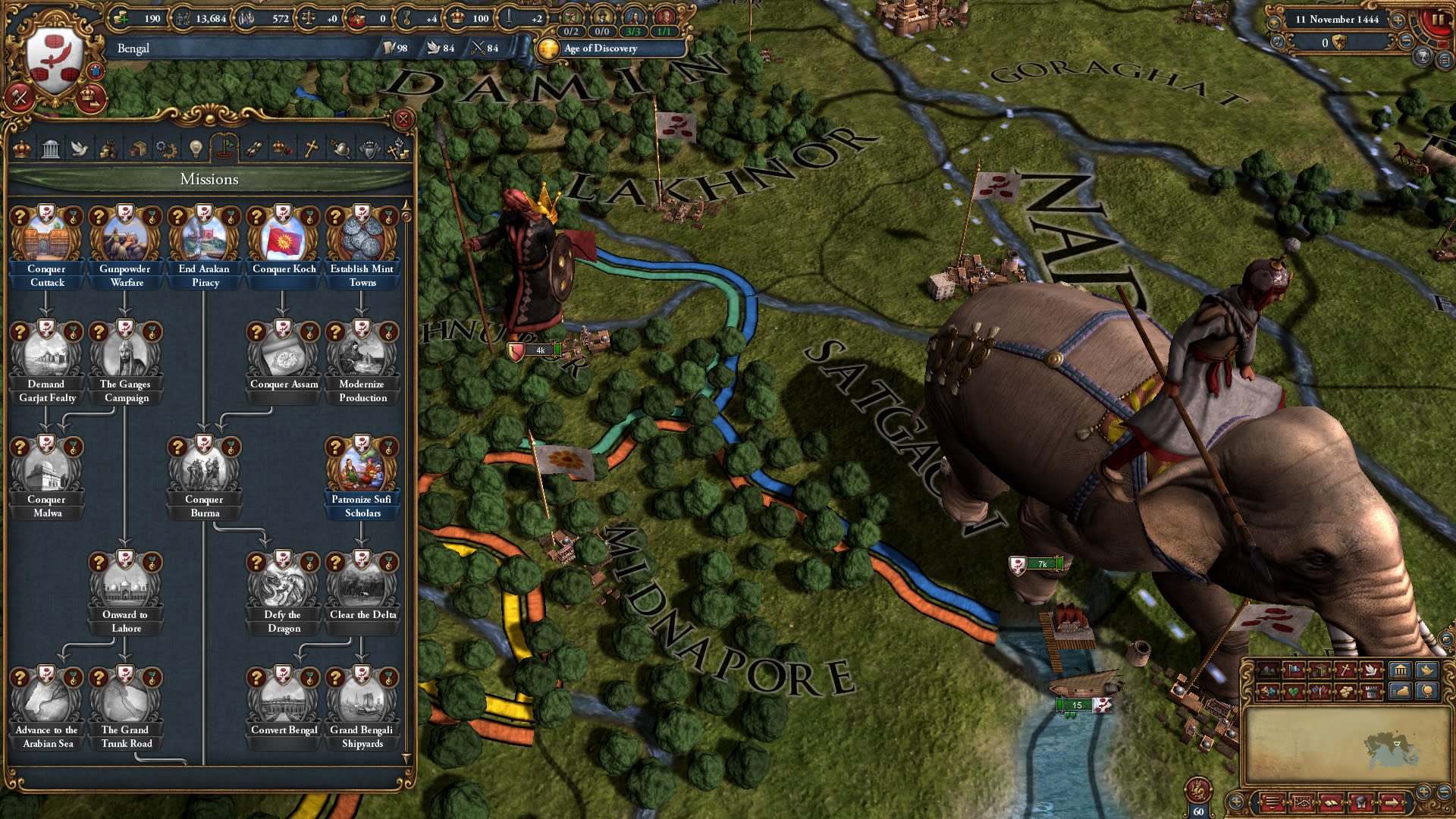
Government reforms add another layer of long-term progression, allowing players to gradually reshape how their nation operates over time. These choices influence administrative efficiency, military strength, and diplomatic flexibility, creating a sense of evolving identity throughout each campaign.
Set in a historically inspired sandbox, Dharma emphasizes regional depth, particularly in South Asia, where political fragmentation and cultural diversity create unpredictable strategic scenarios. This makes every playthrough feel different, as alliances, conflicts, and opportunities rarely follow a fixed path.
Designed for players who enjoy deep strategy games on PC, it rewards patience, planning, and adaptability. Whether you prefer expansion through conquest, trade dominance, or diplomatic influence, the systems support multiple approaches without forcing a single playstyle.
Europa Universalis IV: Dharma ultimately stands out for how it turns internal politics into a living system, where managing people is just as important as managing borders.
Gameplay
Europa Universalis IV: Dharma builds on the core grand strategy gameplay by expanding how players manage nations during the early modern period, with a strong focus on the Indian subcontinent. The gameplay revolves around guiding a country through centuries of political change, where every decision affects stability, growth, and long-term survival.
At its core, the experience is driven by a constant cycle of expansion, administration, and adaptation. Players spend time negotiating diplomacy with rival states, managing internal estates, developing provinces, and controlling trade routes that shape the flow of global wealth. Military campaigns are only one part of the strategy, as success often depends just as much on economic planning and political balance.
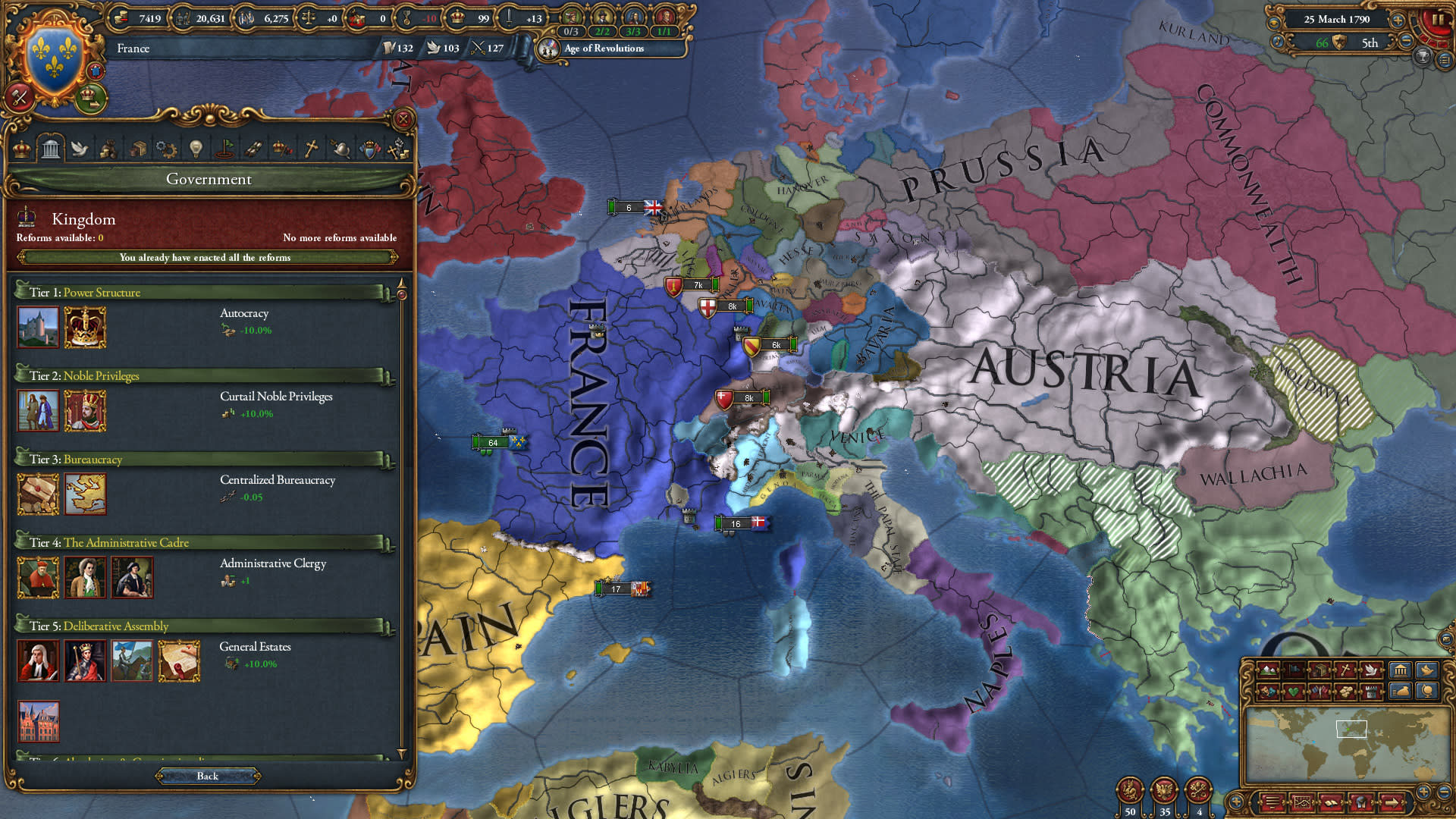
Combat in Europa Universalis IV remains tactical and map-based, but Dharma adds more weight to internal management systems that influence how effectively an empire can sustain wars and expansion. Strong governance becomes essential, especially when dealing with powerful estate groups that demand privileges in exchange for loyalty and stability.
The expansion enhances progression through government reforms and evolving administrative choices, allowing players to shape how their nation functions over time. These systems create a layered sense of growth, where early-game survival gradually transforms into late-game empire optimization and large-scale geopolitical influence.
Exploration and expansion feel dynamic because regional conditions in India create shifting alliances, fragmented territories, and competing powers. This leads to highly replayable campaigns where no two playthroughs develop in the same way, encouraging experimentation with different strategies.
Whether playing single-player or engaging in multiplayer campaigns, the experience rewards patience, long-term planning, and adaptive thinking. Players who enjoy deep strategy games, political simulation, and complex decision-making systems will find a gameplay loop that constantly evolves, keeping each session unpredictable and engaging as their empire grows across centuries.
Story & World
Europa Universalis IV: Dharma is set during the early modern era, a time when empires are expanding, trade routes are shifting, and political power is constantly being redefined across continents. This expansion focuses on the Indian subcontinent, one of the most culturally rich and politically complex regions of the world, where kingdoms, sultanates, and emerging colonial interests all compete for influence. The world feels layered and alive, shaped by centuries of history, where no single force fully controls the balance of power.
At the center of this setting is the player, acting as the guiding force behind a rising or struggling nation. Rather than following a fixed storyline, the world responds to your decisions, creating an evolving historical sandbox where events are shaped by diplomacy, ambition, and survival. You are not just observing history unfold—you are actively rewriting it through choices that affect borders, economies, and alliances over long periods of time.
The world of Dharma feels distinct because of its regional depth. The Indian subcontinent is portrayed as a dense mosaic of cultures, religions, and political structures, each with its own identity and ambitions. Powerful kingdoms rise and fall, while smaller states struggle to maintain independence in the shadow of larger empires. Trade networks stretch across land and sea, connecting distant regions and turning commerce into a driving force of political change.
What makes this setting stand out in a grand strategy and open-world simulation context is its sense of unpredictability. Borders are never static, and alliances shift based on necessity rather than loyalty. A peaceful region can quickly become a battlefield of competing interests, while strong empires may collapse under internal pressure or external expansion. This creates a living historical environment where stability is always temporary.
The atmosphere of Dharma is shaped by contrast—prosperity alongside conflict, tradition alongside transformation. Cities grow through trade and administration, while rural regions reflect the challenges of governance and control. Every nation feels like part of a larger, interconnected system, where decisions in one region can ripple across continents.
There is no single protagonist or fixed narrative arc. Instead, the story emerges naturally through player-driven history. A small kingdom might rise to dominate trade routes, or a powerful empire might struggle to maintain unity under competing internal forces. Each campaign becomes a unique historical narrative shaped by the player’s interpretation of power and survival.
This world is designed for players who enjoy deep strategy RPG-style thinking within a historical simulation framework. It rewards curiosity, patience, and long-term vision, inviting players to explore how societies evolve when ambition, culture, and conflict intersect over centuries.
Game Modes
Europa Universalis IV: Dharma is experienced primarily through a deep single-player grand strategy sandbox, where every campaign plays out as a long-form historical simulation. In this mode, players take control of a nation and guide it through centuries of political change, managing diplomacy, warfare, trade, and internal governance. The Dharma expansion adds more depth to this solo experience, especially through estate systems and regional mechanics in the Indian subcontinent, making each decision feel more grounded in the shifting realities of power.
For players who enjoy shared strategy experiences, multiplayer campaigns offer a different kind of intensity. Here, multiple players control rival or allied nations in the same evolving world, where diplomacy becomes unpredictable and long-term alliances are often tested. These sessions tend to feel more dynamic than single-player, as human decision-making replaces AI behavior, creating emergent stories shaped by negotiation, rivalry, and coordinated expansion.
There is also a more flexible sandbox-style approach within both single and multiplayer play, where players can set their own goals rather than following any fixed narrative structure. Some focus on building trade empires, others on military conquest, while many experiment with surviving as smaller states against larger regional powers. Dharma enhances this freedom by making internal politics and regional identity more impactful, especially in densely populated and politically complex areas.
Challenge-driven play also naturally emerges through the game’s systems, even without formal mission-based modes. Players often create self-imposed objectives such as restoring fallen empires or dominating specific trade routes, which adds replay value and keeps each run feeling distinct.
Across all modes, the experience remains grounded in long-term strategic decision-making rather than short bursts of action. Whether played solo for immersion or in multiplayer for unpredictability, Europa Universalis IV: Dharma supports a wide range of strategy playstyles, ensuring that every campaign unfolds differently based on who is playing and how they choose to shape history.
Visuals & Art Style
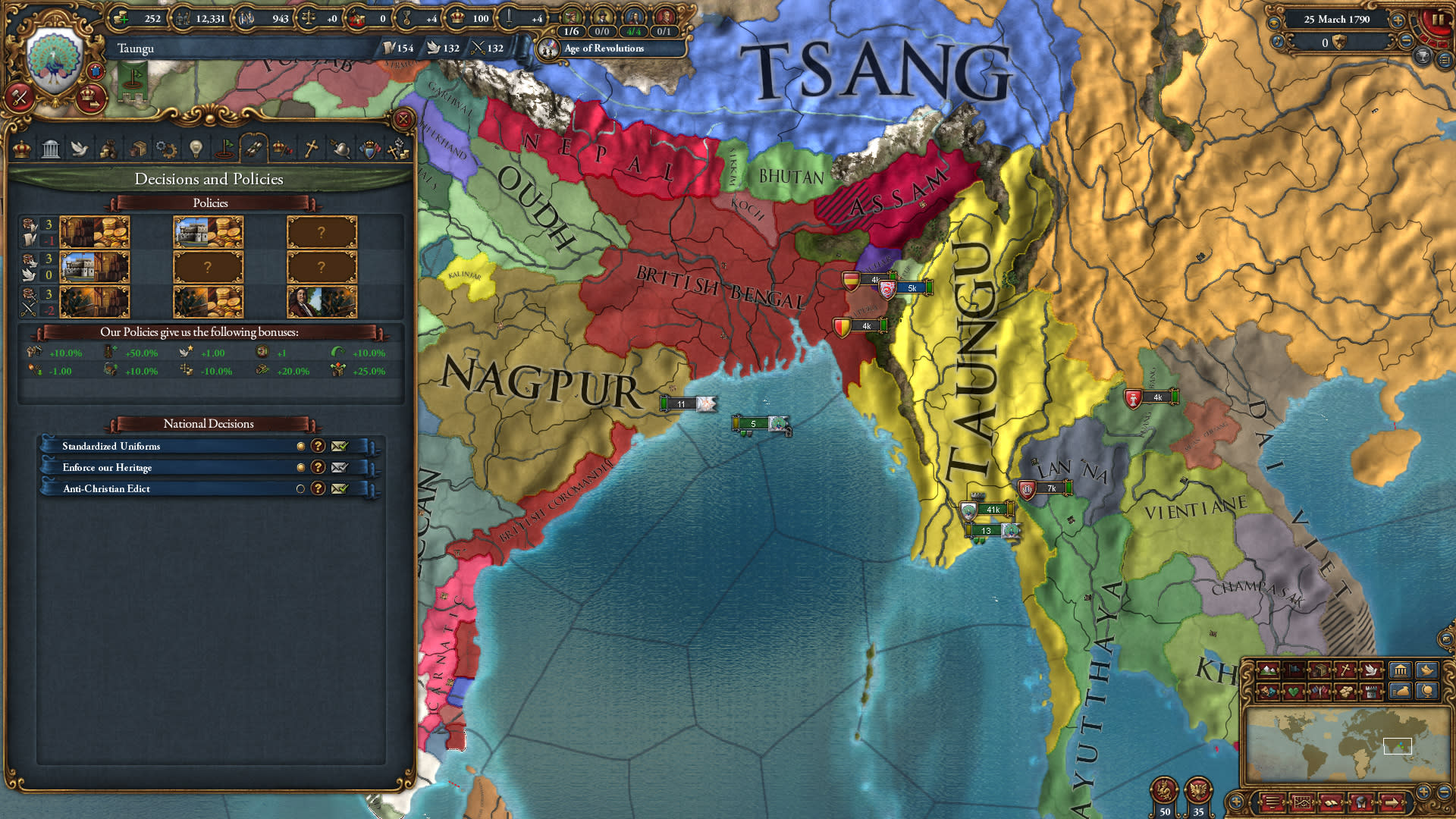
Europa Universalis IV: Dharma presents a visual style rooted in clarity and historical atmosphere rather than cinematic spectacle. The game uses a detailed political map as its main visual stage, where the world is represented through regions, borders, and cultural overlays that shift dynamically as empires rise and fall. At first glance, it may appear minimalist, but the longer you watch the map evolve, the more alive it feels, with changing colors, expanding territories, and constantly moving frontlines that reflect centuries of transformation.
The Dharma expansion adds noticeable depth to this presentation, especially across the Indian subcontinent. Provinces are more visually distinct, with richer cultural tones and varied terrain that reflect the diversity of the region. From fertile river valleys to arid inland territories and coastal trade hubs, the environment communicates strategic importance without needing words. This makes exploration of the map feel more meaningful, as every region carries its own visual identity tied to its political and economic role.
Lighting and interface design remain clean and functional, ensuring that even during complex late-game scenarios, information is readable without overwhelming the player. Subtle visual cues highlight unrest, prosperity, or conflict, allowing players to understand the state of their empire at a glance. Animations are restrained but purposeful, with unit movements, trade flows, and diplomatic changes represented in a way that supports long-term strategic thinking rather than fast-paced action.
What stands out most is how consistently the visual design supports immersion in a historical grand strategy setting. Instead of flashy effects, the game relies on layered map detail and evolving world states to create a sense of scale. Over time, the map itself becomes a visual narrative of player decisions, showing expansion, fragmentation, and cultural change in a way that feels organic.
The result is an art style that may seem understated at first, but gradually reveals its strength through depth, readability, and constant transformation, making the world of Europa Universalis IV: Dharma feel like a living historical canvas shaped directly by the player’s actions.
Technical Requirements
Europa Universalis IV: Dharma is a PC-first grand strategy expansion, designed to run smoothly on a wide range of systems while scaling well for more powerful hardware. Since it builds on Europa Universalis IV, it follows the same baseline system requirements as the main game. On most modern PCs, including mid-range setups, the game runs comfortably with a multi-core processor, 8 GB of RAM, and an integrated or dedicated graphics card. For the best experience, a stronger CPU and 16 GB RAM are recommended, especially for late-game campaigns where the world simulation becomes more complex.
The DLC is available on PC through major storefronts, including Steam, and is also supported on Linux and macOS versions of the base game, ensuring broader compatibility across desktop platforms. There are no console versions, as the experience is designed specifically around mouse-and-keyboard strategy gameplay.
Performance in Dharma remains stable even during large-scale empire simulations, though frame pacing can vary in very late-game scenarios due to the depth of global AI calculations. Load times are generally short on SSDs and slightly longer on HDDs, but overall optimization ensures smooth transitions between map views, menus, and long campaign sessions. The game scales visually and computationally, meaning lower-end systems can still run it with reduced settings without losing core gameplay clarity.
Controls are fully optimized for keyboard and mouse, which is essential for precise map navigation, diplomacy management, and rapid decision-making. The interface is highly customizable, allowing players to adjust shortcuts and UI elements to match their preferred playstyle. While there is no native controller support, the control scheme is intuitive and built specifically for PC strategy gameplay.
Accessibility options include scalable UI elements, adjustable text size, and subtitle support for in-game notifications and events. Players can also tweak audio levels across different systems such as music, effects, and ambient world sounds. Combined with its flexible difficulty through AI settings and game rules customization, Dharma ensures that both newcomers and experienced grand strategy players can tailor the experience to their comfort level while maintaining full strategic depth.
Who Is This Game For?
Europa Universalis IV: Dharma is best suited for players who enjoy deep, slow-burn strategy games where decisions matter over long stretches of time rather than instant results. It appeals strongly to fans of historical simulation, grand strategy, and empire-building gameplay, especially those who like managing complex systems such as diplomacy, trade, and internal politics. If you enjoy thinking several steps ahead, planning long-term expansion, and watching a world evolve based on your choices, this expansion fits naturally into that style of play.
Players who are drawn to sandbox experiences with high replayability will find a lot of value here. Each campaign can unfold differently depending on the nation you choose and the strategies you adopt, making it ideal for those who enjoy experimenting with different approaches to strategy gameplay. Whether you prefer economic dominance, military expansion, or careful diplomatic balancing, the systems support multiple playstyles without forcing a single path.
It is especially rewarding for players who appreciate detailed political simulation and region-specific depth. Dharma’s focus on governance systems and estate management adds more complexity to internal decision-making, which will appeal to those who enjoy layered mechanics and gradual progression rather than fast-paced action. Multiplayer strategy fans will also find value in competitive or cooperative campaigns where human unpredictability creates unique scenarios.
However, this is not a game for players looking for quick matches, action-heavy combat, or immediate gratification. The learning curve can feel steep at first, and the pace is intentionally methodical. Players who prefer linear storytelling or fast reflex gameplay may find the experience slower than expected, especially in the early stages.
Overall, Europa Universalis IV: Dharma is designed for strategy enthusiasts, history fans, and patient thinkers who enjoy long-form gameplay where every choice builds toward a larger outcome. It rewards curiosity, experimentation, and persistence, making it a strong fit for players who value depth and replayability in a grand strategy experience.
FAQ
What kind of game is Europa Universalis IV: Dharma?
It is a grand strategy expansion focused on deep historical simulation. Players manage nations through diplomacy, trade, warfare, and internal politics during the early modern era, with Dharma adding extra depth to the Indian subcontinent and governance systems.
Who will enjoy this DLC the most?
It is best suited for players who enjoy complex strategy gameplay, long-term planning, and historical world simulation. Fans of slow, thoughtful decision-making and empire management will get the most value from it.
Can I play it solo or is multiplayer required?
The game is fully playable in single-player mode and is designed primarily around that experience. Multiplayer is optional and offers a more unpredictable, competitive strategy environment with other players.
What platforms is it available on?
Europa Universalis IV: Dharma is available on PC through digital platforms like Steam. It also supports Linux and macOS through the base game’s compatibility options.
Will it run on my system?
The DLC uses the same requirements as Europa Universalis IV. Most modern PCs can run it smoothly. A stable processor, 8 GB RAM, and a dedicated or integrated GPU are enough for good performance, while stronger systems handle late-game scenarios more comfortably.
Is the game beginner-friendly?
It has a learning curve, especially for new strategy players, but the experience becomes more intuitive over time. Players who enjoy learning layered systems will adapt well.
How much replay value does it offer?
Very high. Each campaign changes based on your nation, decisions, and regional dynamics, meaning no two playthroughs feel the same.
Does it require an internet connection?
No constant internet connection is needed for single-player. Multiplayer does require online access.
Are there additional DLCs or expansions?
Yes, Dharma is an expansion and works alongside other Europa Universalis IV content for a more complete experience.
Is it more casual or hardcore?
It leans toward hardcore strategy, but patient casual players who enjoy deep systems can still enjoy it with time.
FAQ
Operating System (OS)
Other Details

Languages


Reviews
There are no reviews yet.